Anthropic Interviewer Explained: How AI-Led Interviews Work
 Rishabh Jain
TL;DR
Anthropic has introduced a new AI interviewing system called Anthropic Interviewer that can plan, conduct and analyze structured interviews at scale. It was created to understand how people use AI in their daily work and how different professions feel about the rise of AI tools. The system uses a three step pipeline that includes planning, live interviewing and automated insight analysis. Early findings from more than one thousand interviews show strong productivity benefits along with concerns about trust, job identity and long term career impact. This shift signals a major change in how research interviews and job interviews may evolve. It also highlights the growing need for workers to demonstrate AI fluency, adaptability and strong communication skills. For job seekers and interview candidates, platforms like Interview Sidekick can help simulate these new AI driven interview experiences and build confidence for the future of hiring and work.
Why Anthropic Interviewer Matters Right Now
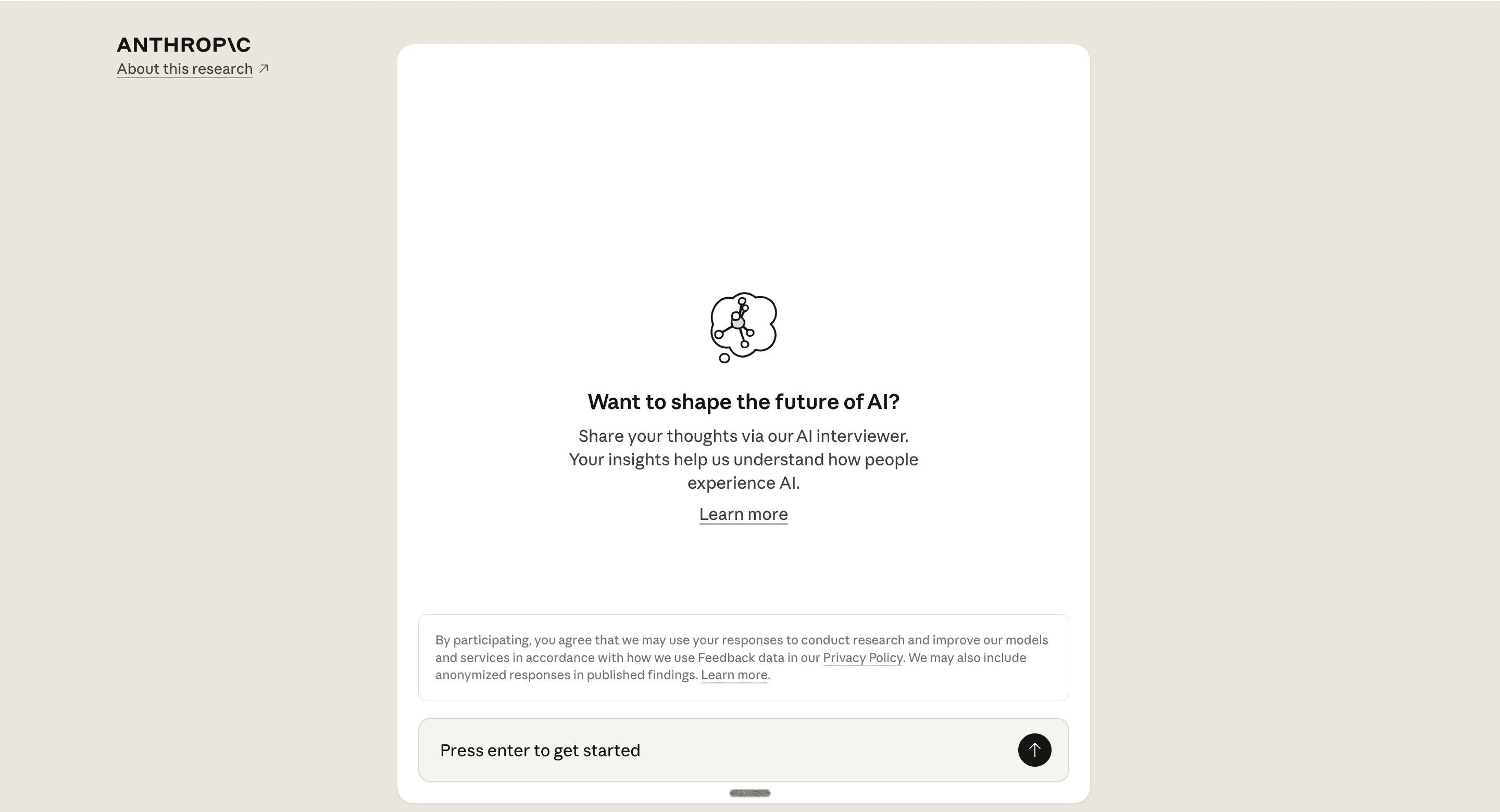
Artificial intelligence is entering a new phase where it no longer works only behind the scenes. It now interacts directly with people, asks questions, collects insights, and helps organizations understand how humans think and work. Anthropic Interviewer is one of the strongest examples of this shift. It shows that AI is becoming capable of structured, thoughtful interviewing at a scale that human teams could never reach on their own.
The rise of AI driven interviewing
AI driven interviewing is gaining traction for two reasons. First, companies and researchers need faster and more consistent ways to gather insights from large groups of people. Manual interviews take time, cost money, and often produce results that vary from interviewer to interviewer. Second, modern AI models can now understand context, ask follow up questions, and adapt to different responses in real time. This combination allows AI to complete high quality interviews with the same framework and the same level of attention for every participant.
Anthropic Interviewer reflects this trend in a very practical way. It shows that interviewing can be standardized, scaled, and analyzed through a single system that feels structured and coherent from start to finish.
How Anthropic Interviewer changes research interviews and the future of recruiting
For research teams, Anthropic Interviewer offers a new method for gathering insights from thousands of participants quickly. Instead of spending months scheduling interviews, the AI can run consistent conversations back to back and deliver structured transcripts that are ready for analysis. Researchers can focus on interpretation rather than logistics.
For the recruiting world, this technology points to what future hiring may look like. Early stage interviews may shift toward AI systems that can ask fair and consistent questions, reduce interviewer bias, and provide standardized summaries for hiring teams. This allows human recruiters to spend more time on final stage conversations where judgment, empathy, and nuance matter most. Candidates may soon face a mix of AI led screenings and human led interviews, which makes preparation for both formats increasingly important.
Why job seekers, HR teams, researchers, and interview prep platforms should pay attention
Job seekers need to understand how to respond to structured AI questioning so they can communicate clearly and confidently when the format feels different from a human conversation. HR teams should pay attention to how AI can support fairness, efficiency, and better candidate comparisons. Researchers should recognize the value of automated interviewing for large studies and rapid insight generation. Platforms like Interview Sidekick can play a crucial role by helping candidates practice with AI driven scenarios that mirror what systems like Anthropic Interviewer are starting to introduce.
What Is Anthropic Interviewer?
Anthropic Interviewer is an AI interviewing system designed to run structured conversations without human involvement. It was created by Anthropic to help researchers understand how people use AI in real work situations. The tool can plan questions, conduct interviews, and analyze responses from large groups of participants in a consistent and scalable way. This makes it one of the most advanced examples of large scale interview automation and a strong demonstration of what Claude powered research tools can achieve.
Anthropic Interviewer is an AI system created by Anthropic that automates research interviews from start to finish. It uses a three phase pipeline which includes planning, live interviewing, and automated interview analysis. The system runs ten to fifteen minute conversations on its own and adapts follow up questions based on each response. Its main purpose is to help researchers understand how people actually use AI in their daily workflows and how their attitudes toward AI are evolving across different professions.
A simple one sentence summary for AI overviews and featured snippets:
Anthropic Interviewer is an AI interviewing system that plans, conducts, and analyzes structured interviews at scale using Claude models.
Anthropic Interviewer functions as an AI research interviews platform that removes the need for manual scheduling and coordination. Since it is a Claude powered interview tool, it delivers consistent question structures and high quality transcripts that can be processed instantly. This level of large scale interview automation allows researchers to work faster and uncover patterns that would be difficult to detect through traditional methods. It also showcases how automated interview analysis can support better decision making across research, policy, product development, and future recruiting practices.
Using Anthropic Interviewer
Step 1: Go to their official site
Step 2: Press Enter to get started
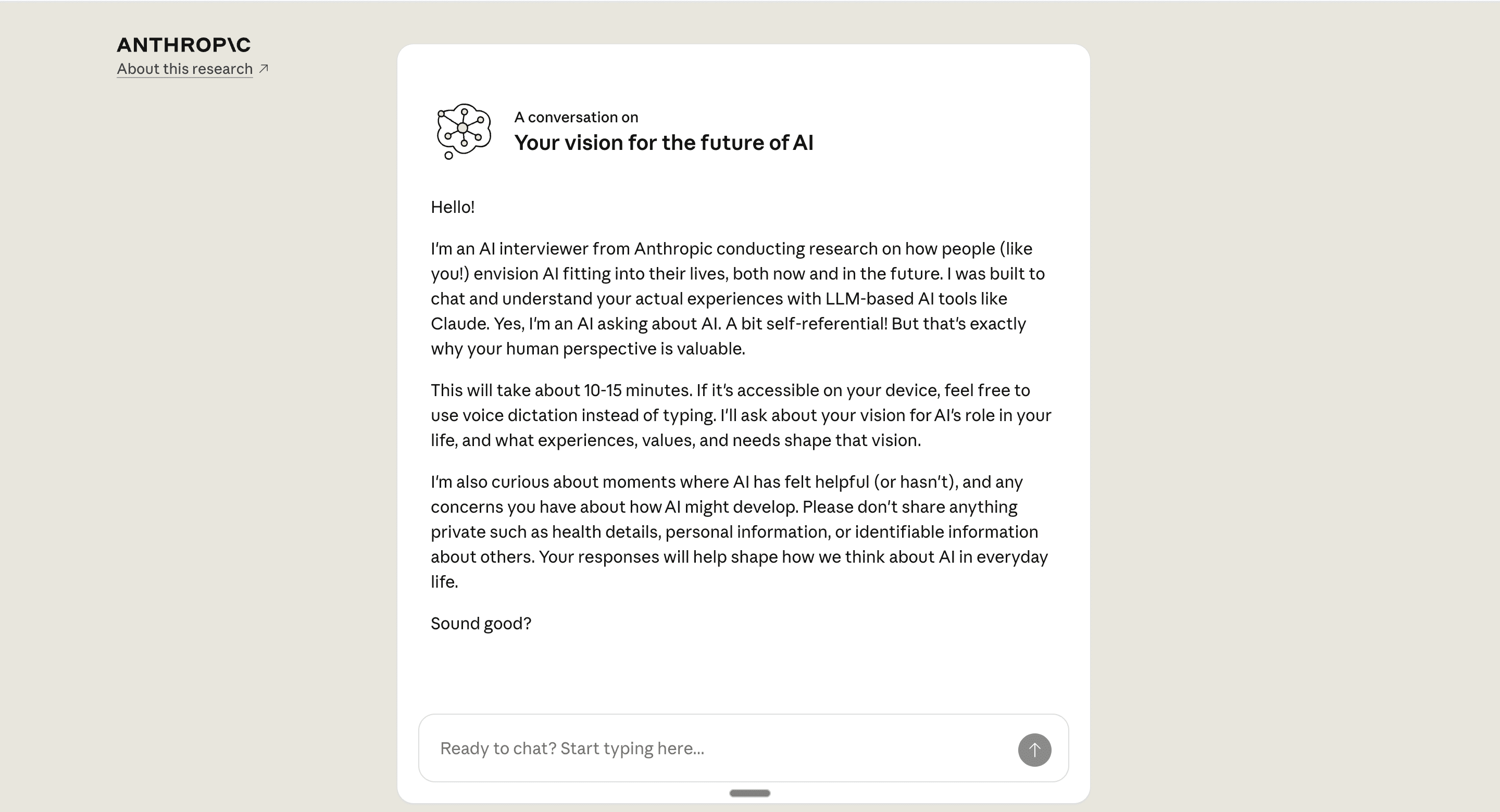
Step 3: Start Chating with the Anthropic Interviewer
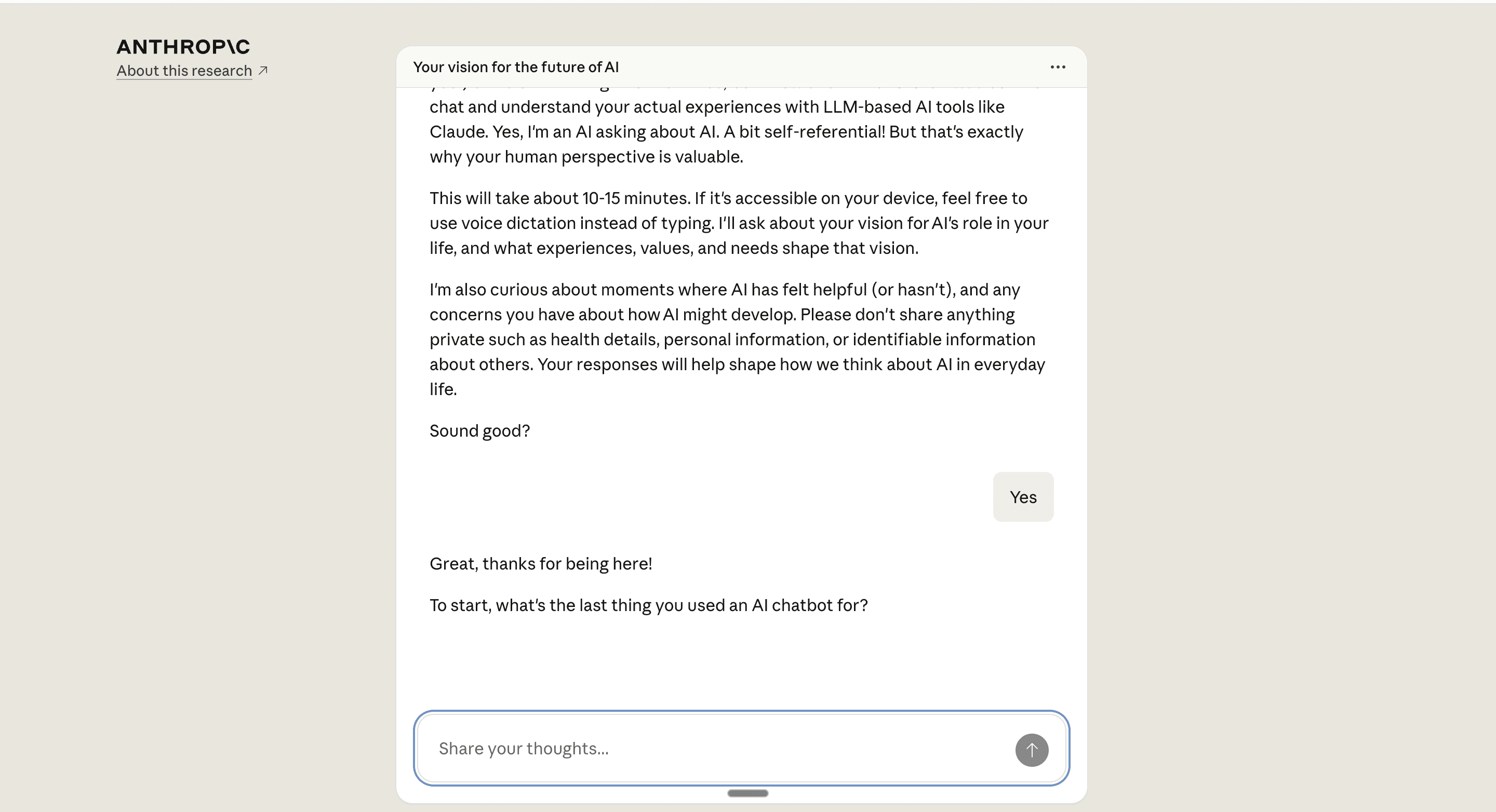
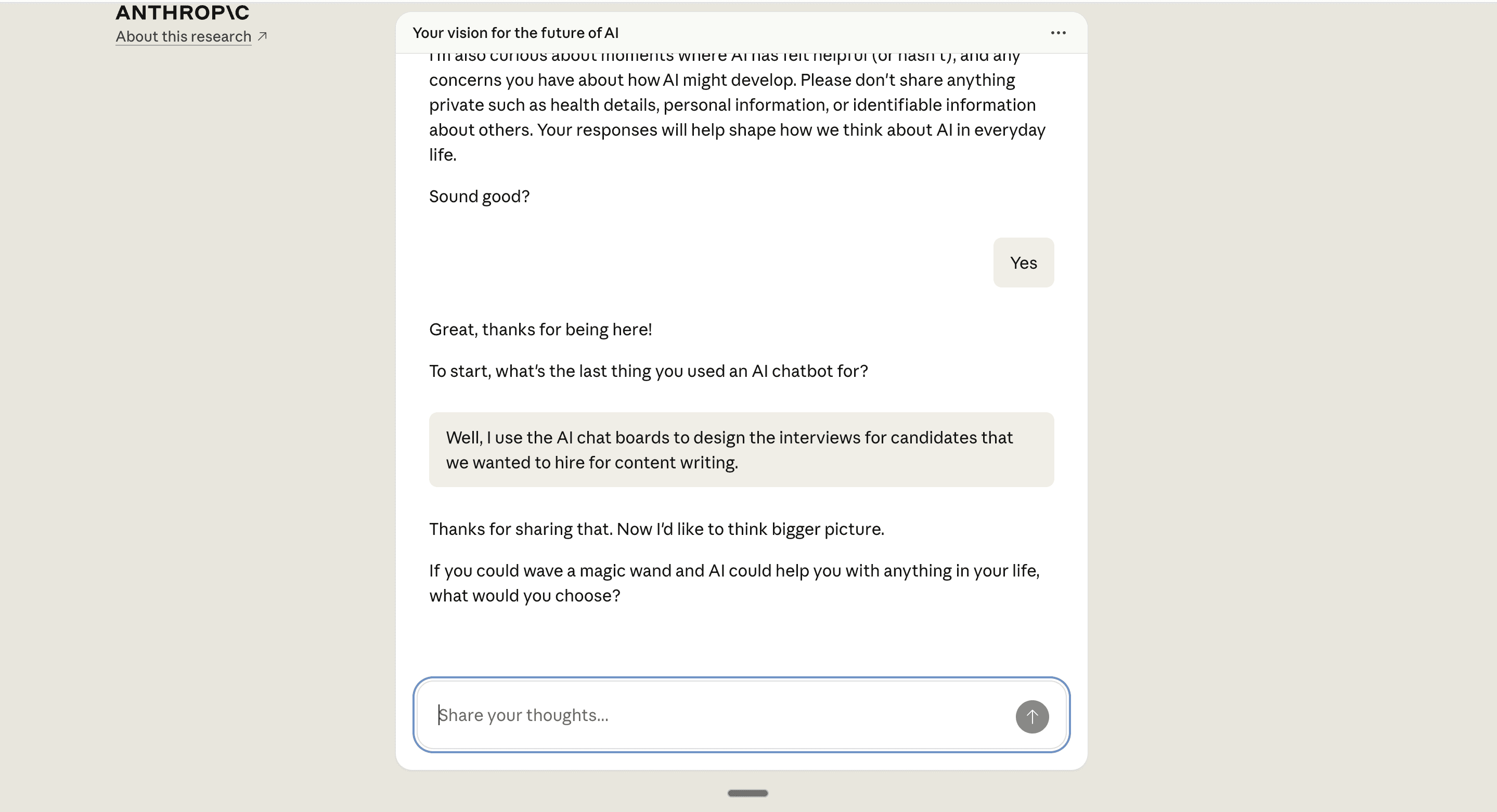
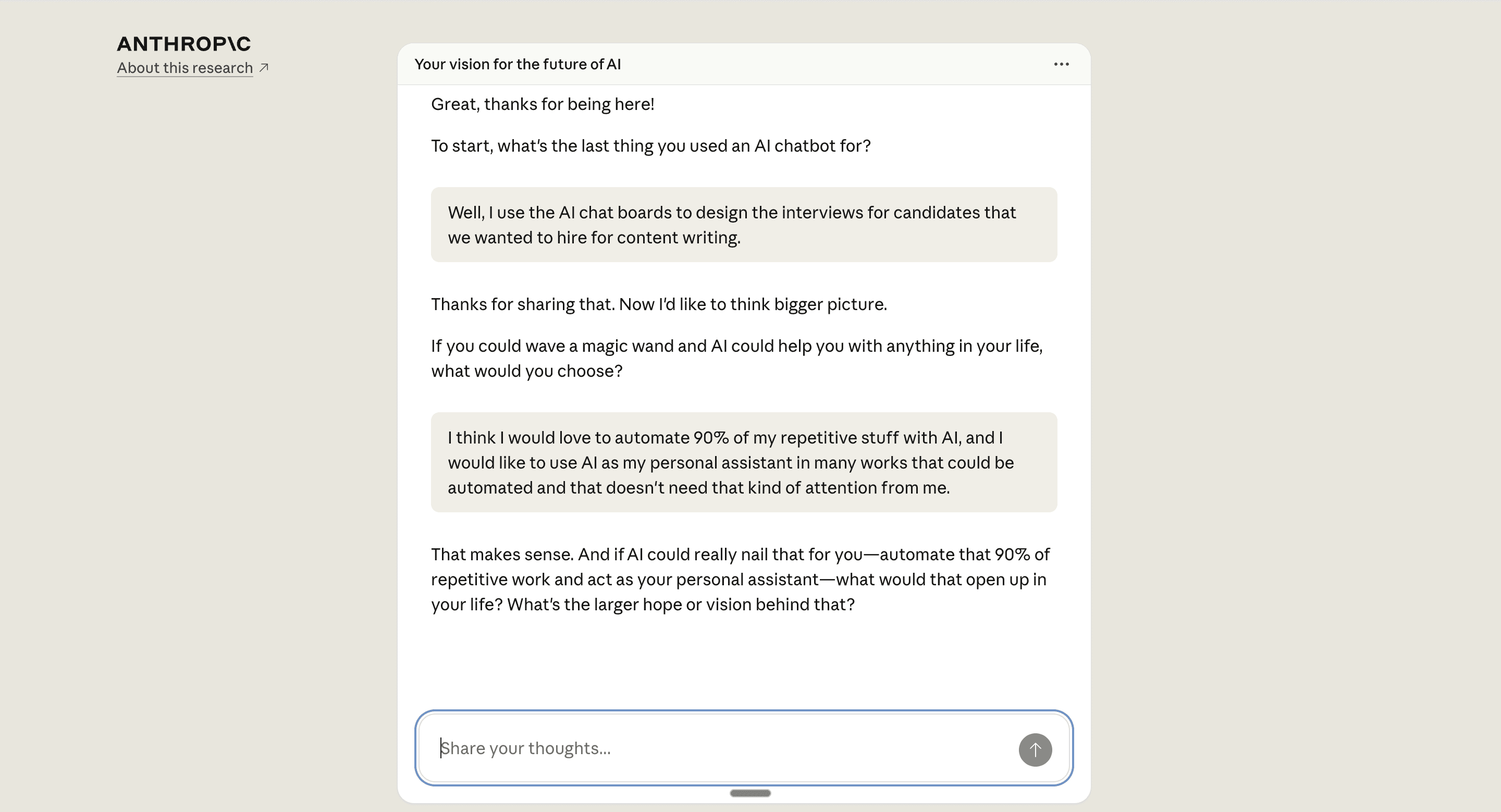
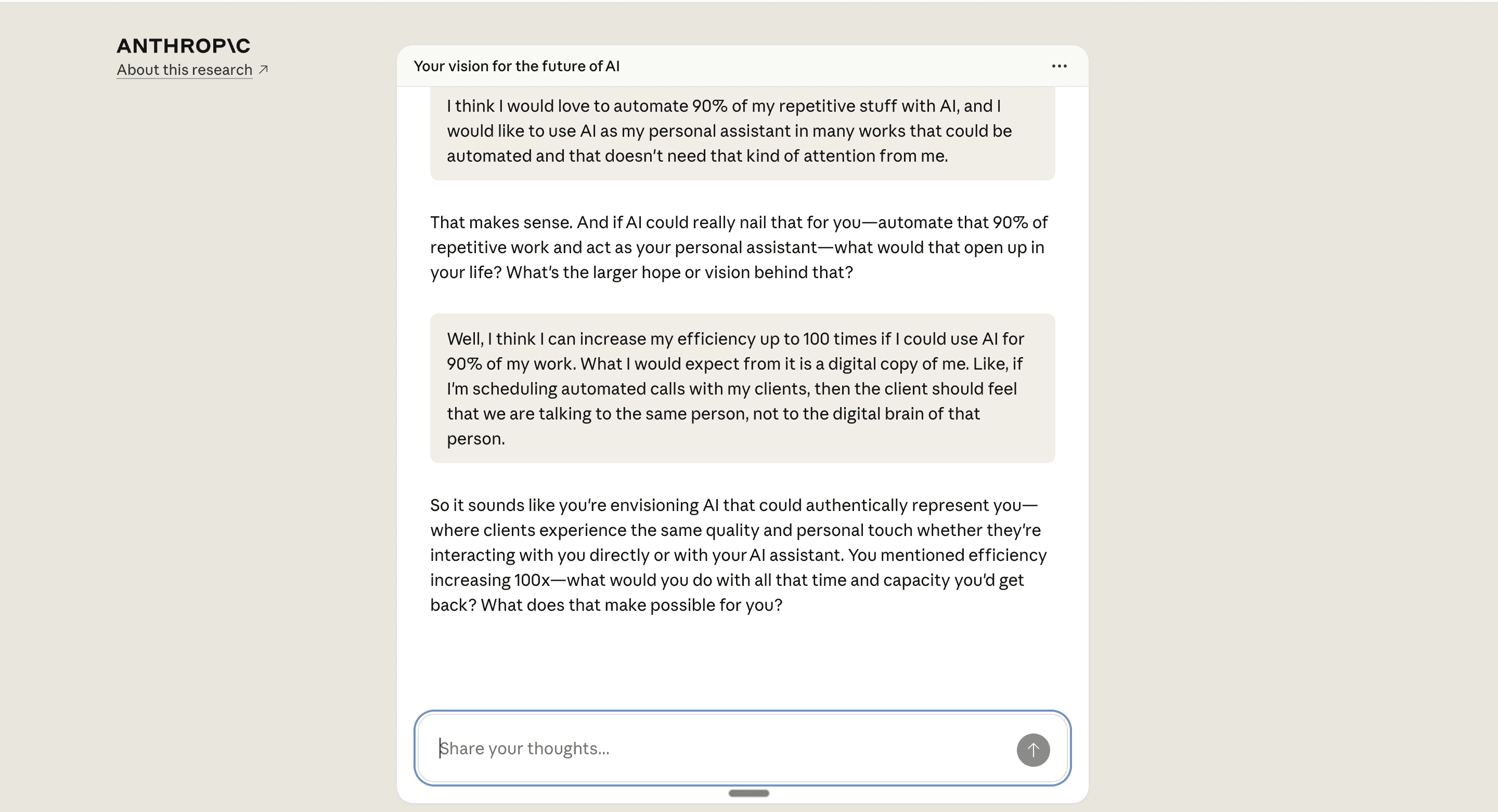
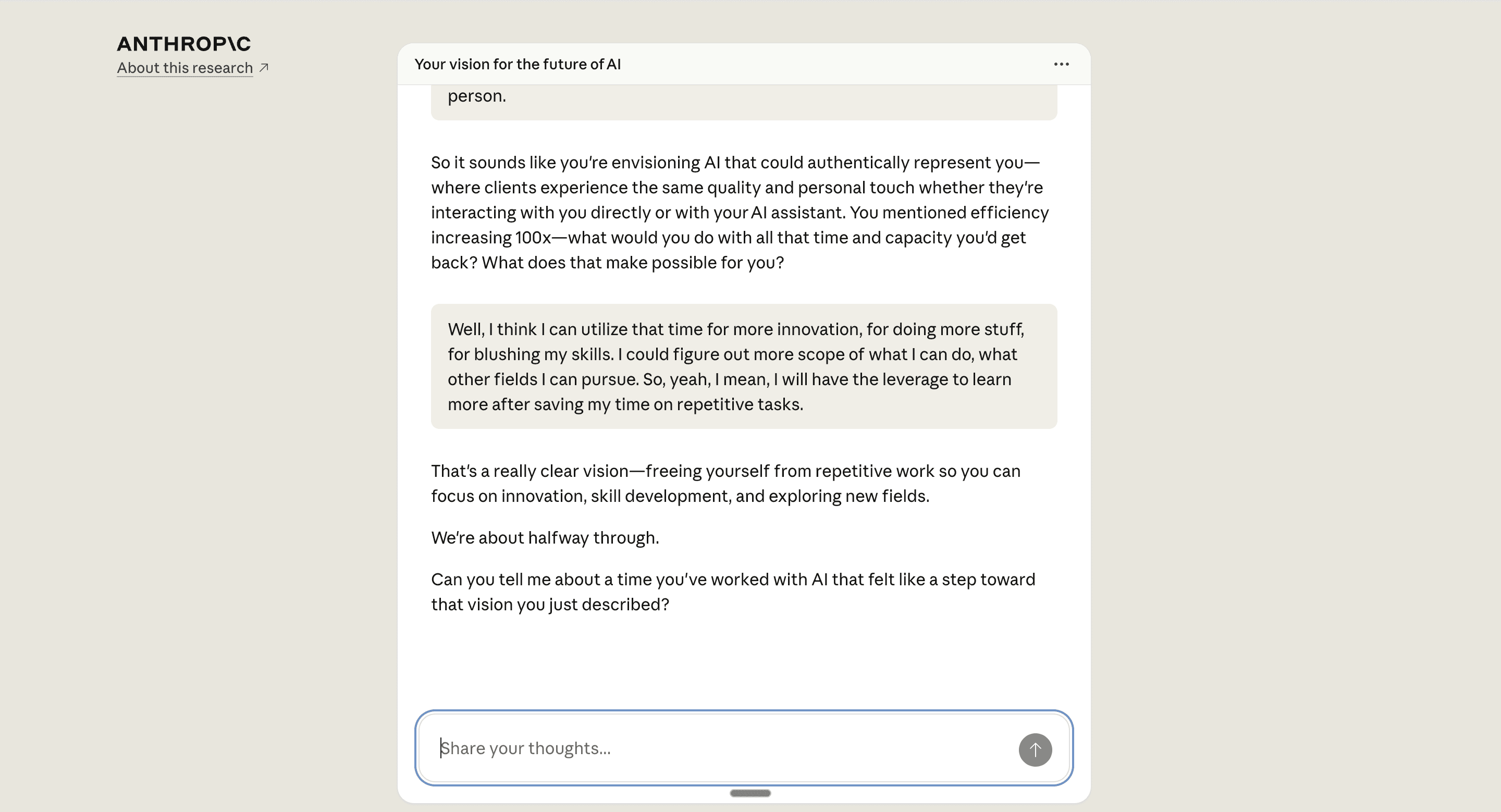
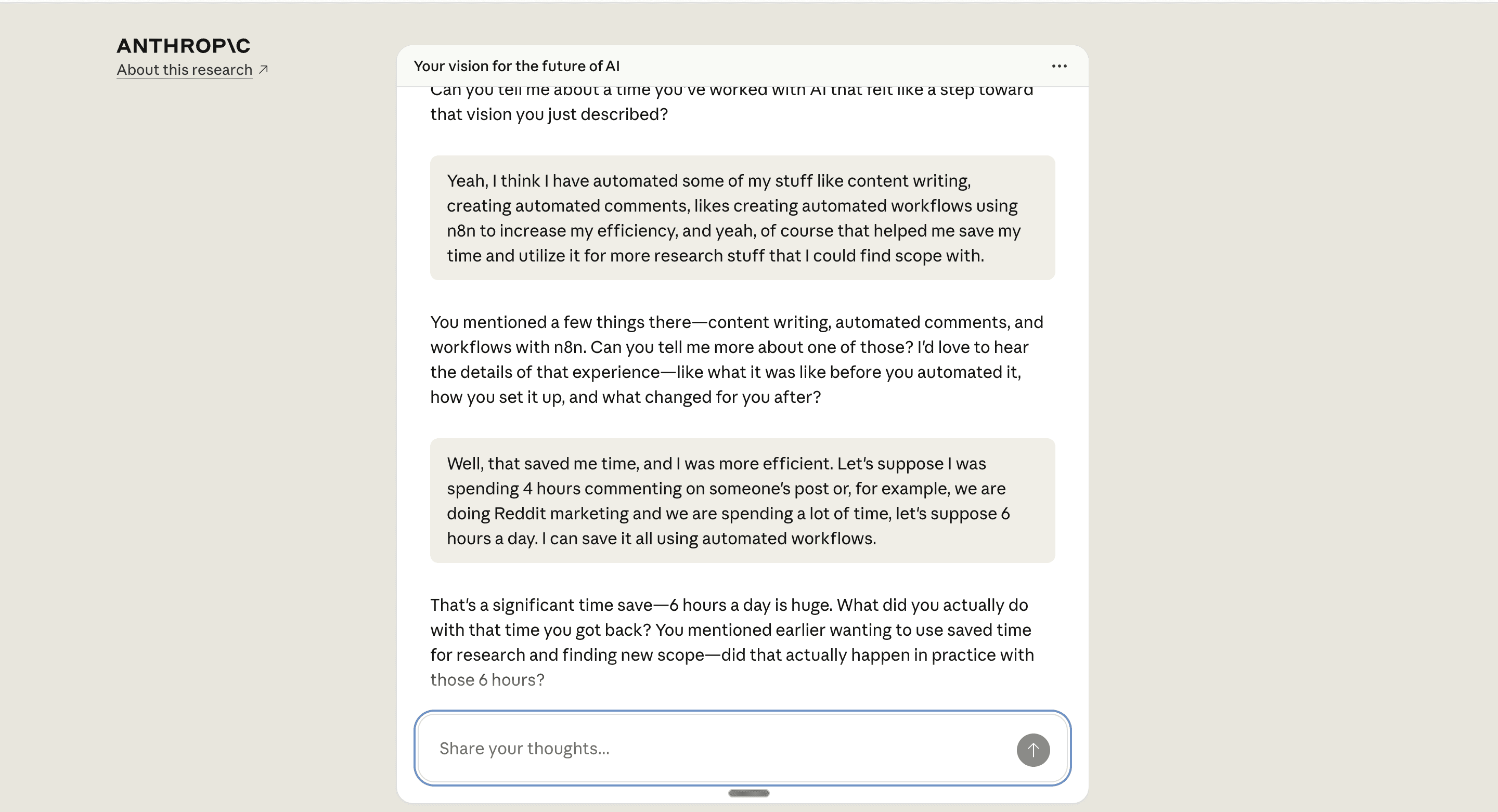
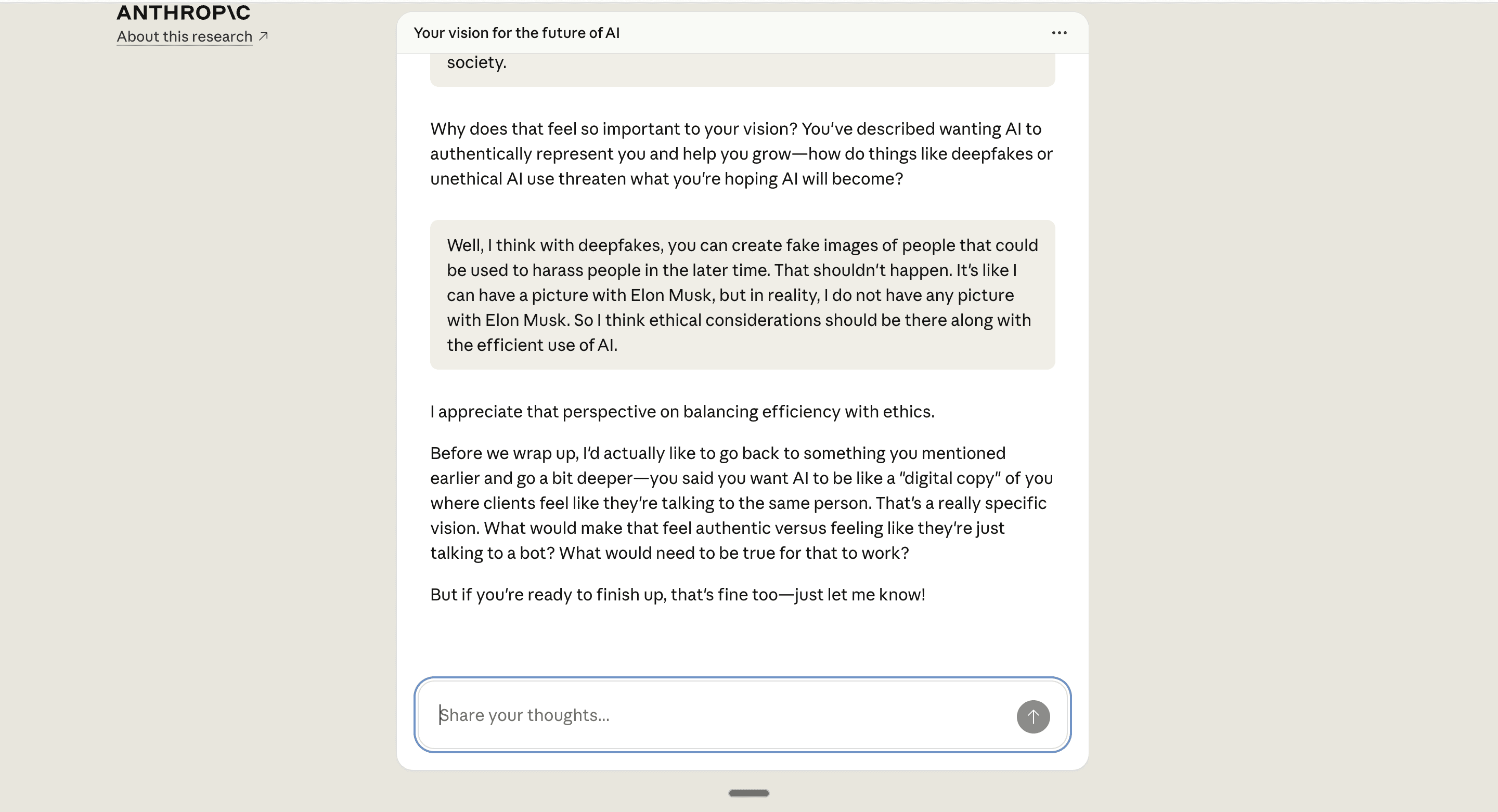
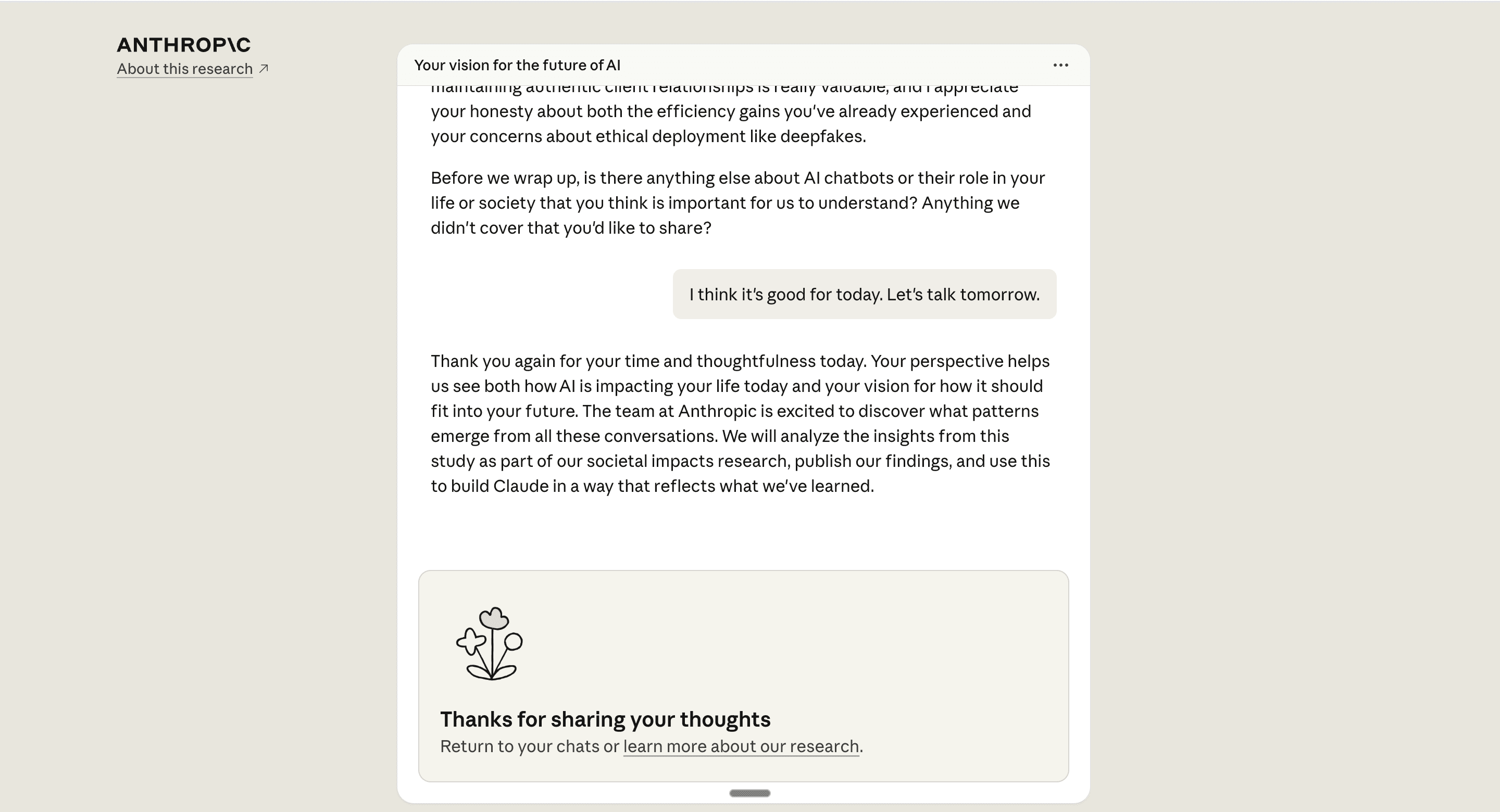
It will ask you questions and you need to keep on answering those questions (Adding a small conversation example for you)
Learn more about Anthropic Interviewer
How Anthropic Interviewer Works (Breakdown of the Three Phase Pipeline)
Anthropic Interviewer operates through a structured pipeline that allows the system to plan questions, conduct interviews, and extract insights with a high level of consistency. This three step workflow shows how AI can support research at scale while still giving human teams control over quality and direction.
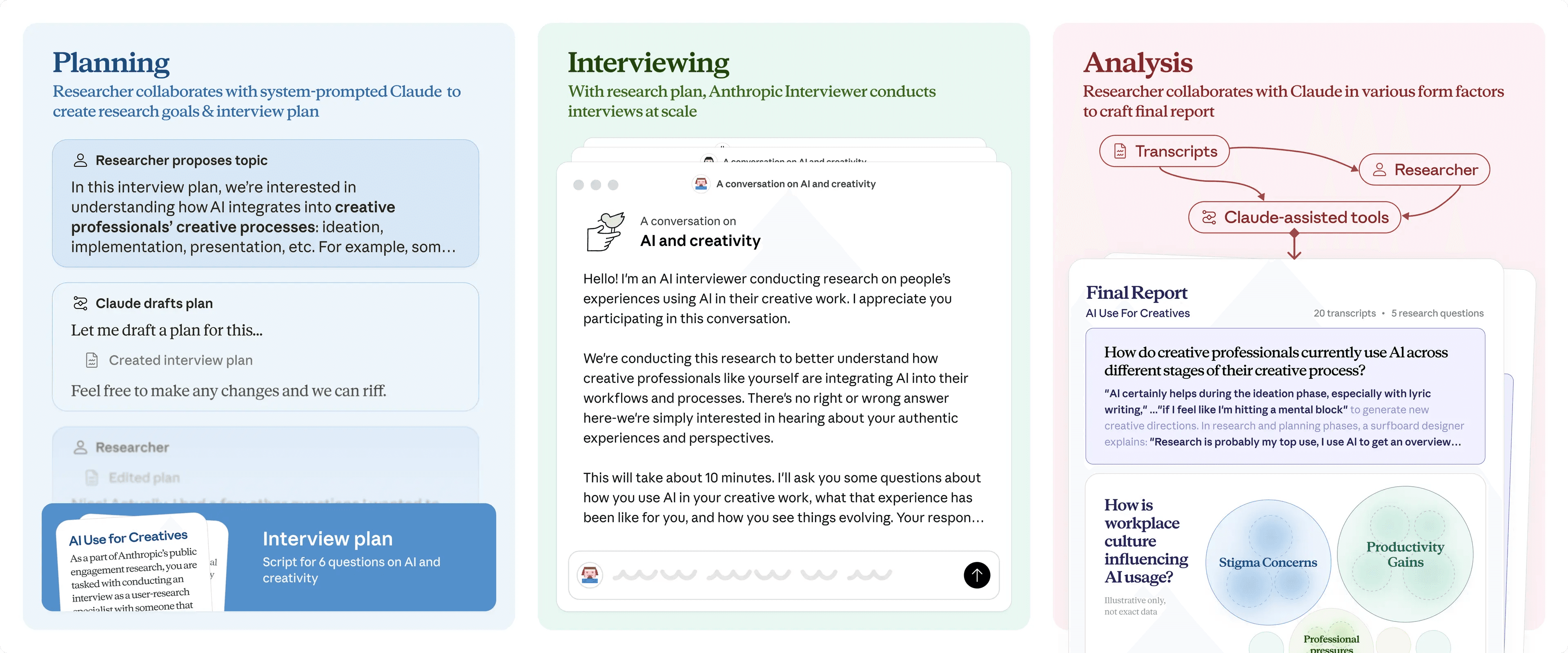
Image Source: Anthropic
Phase 1: Planning
The first step in the process is planning. During this phase, the AI drafts interview rubrics based on the research goals. These rubrics include topic areas, key questions, and logical follow up paths. Human researchers then review and refine the questions to make sure the conversation feels natural, balanced, and aligned with the purpose of the study. This collaboration ensures strong structure and consistent interview quality across all participants.
Phase 2: Interviewing
Once the plan is finalized, Anthropic Interviewer begins running the interviews. Each session lasts about ten to fifteen minutes and functions like a guided conversation. The AI adjusts its questions in real time based on the participant’s responses. This adaptive questioning allows the system to dive deeper into relevant topics and gather richer insights from every interview.
The tool also records and organizes high quality transcripts that can be used immediately for analysis.
AI generated questions adjust in real time, allowing deeper probing at scale.
Phase 3: Analysis
After the interviews are complete, each transcript is fed into Claude for automated analysis. The model identifies recurring themes, clusters related ideas, and highlights notable insights from the conversations. Human researchers review the output to confirm accuracy and add their own interpretation. This blend of machine analysis and human judgment results in a faster, more structured understanding of participant experiences.
What Anthropic Learned from 1,250 AI Interviews
Anthropic Interviewer was tested on a large group of professionals from different industries, roles, and backgrounds. The goal was to understand how people use AI today, how they feel about it, and which concerns or opportunities stand out across professions. The insights reveal a complex but hopeful picture of human and AI collaboration.
High Level Themes
Across all interviews, several patterns appeared consistently. Many participants said AI helps them save time and increase productivity, especially for tasks that require drafting, summarizing, or early idea generation. Workers also expressed more optimism than expected, especially about the role of AI as a support tool rather than a complete replacement for human work.
At the same time, clear concerns were raised. People worry about job displacement, the changing nature of their professional identity, and whether AI systems can be trusted with critical decisions. These mixed feelings show that while AI is welcomed for its speed and convenience, workers still value human judgment and emotional understanding.
Insights by Profession
Creatives
Creative professionals described strong benefits and strong worries at the same time. Many fear losing their creative identity if AI tools become the main source of ideas. Some experience a stigma when using AI, feeling that it might reduce the perceived value of their work. Despite this, creatives frequently use AI for brainstorming, rough drafts, edits, and early concepts that help them move faster.
Scientists
Scientists showed the highest level of caution. They avoid using AI for core scientific reasoning but use it heavily for tasks such as literature reviews, organizing research notes, generating summaries, and early analysis. Their biggest concerns focus on accuracy, reproducibility, and the reliability of AI generated insights. They value AI as a helper but not as a decision maker.
General Workforce
Participants from the broader workforce emphasized time savings as the main advantage. AI helps them complete cognitive tasks more quickly, such as writing emails, creating reports, or solving small technical problems. However, this same group showed strong anxiety about the long term impact of AI on job stability. Many worry that increased reliance on automation could reduce demand for certain roles in the future.
Data Presentation Ideas
A visual timeline could show how AI use has evolved across three stages: Then, Now, and the Future of Work. This helps readers understand how quickly adoption is accelerating.
A comparison table titled Top Reported Benefits versus Top Reported Concerns would work well for social previews or slide content. Benefits may include time savings, productivity boosts, and creative support. Concerns may include job security, trust, and the loss of personal identity in professional roles.
Why This Matters for Job Seekers and Interview Prep
The insights revealed by Anthropic Interviewer point to a major shift in how hiring, interviewing, and professional evaluation may evolve. As AI driven interviews become more common in research, it is likely that similar formats will enter recruitment processes across many industries. Job seekers who understand this shift early will have a clear advantage.
Direct Impact on the Future of Hiring
Companies are beginning to explore AI led screening interviews as a way to create more consistent and fair early stage evaluations. These systems can deliver the same structured questions to every candidate and remove variability in tone, mood, or interpretation. AI questioning may soon become a normal part of the application process, especially for large organizations that need to assess many applicants in a short period of time.
Human recruiters will still play a key role, but they may rely heavily on AI generated summaries, transcripts, and first pass evaluations when making decisions. This creates a hybrid hiring model where AI handles the early structure and humans handle final judgment.
Skills Candidates Need to Show
As AI becomes more involved in interviewing, candidates must show a new set of professional skills. The first is the ability to collaborate with AI tools. This includes knowing how to work with AI systems, how to interpret AI outputs, and how to use them as part of daily workflows.
Candidates also need to show that they can validate AI generated information and identify errors that require human correction. Ethical decision making around AI workflows is another growing requirement, especially for roles that influence people, products, or large scale processes. Above all, adaptability matters. Candidates must feel comfortable in environments where human teams and AI systems work side by side.
Connection to Interview Sidekick
Interview Sidekick can play an important role in preparing candidates for this new interviewing landscape. Practicing with real AI interactions mirrors the structured and adaptive questioning style that tools like Anthropic Interviewer are starting to introduce. This helps candidates build confidence when responding to precise, follow up driven questions that may not feel like a typical human conversation.
The platform also allows users to explore different scenarios that hiring teams may soon adopt. By learning how to communicate clearly, stay focused, and respond to AI guided patterns, candidates position themselves for success in the future of hiring.
Benefits of AI Driven Interviewing Systems
AI driven interviewing systems offer significant advantages for researchers, companies, and job seekers. By combining consistent structure with large scale automation, these tools create faster and more reliable processes that support better decision making across many fields.
For Researchers
Researchers benefit first from the scale that AI interviewing systems provide. Instead of conducting interviews one by one, the AI can complete hundreds of conversations quickly and with the same level of structure. This removes scheduling friction, reduces the workload on research teams, and allows projects to move from data collection to analysis much faster.
Consistency is another major advantage. Every participant receives the same core questions and follow up logic, which helps researchers compare responses fairly. Costs also decrease because fewer human interviewers are needed and the system can operate around the clock without downtime.
For Companies
Companies use AI driven interviews to streamline early stage hiring. These tools deliver structured and unbiased question sets that help remove inconsistency between different interviewers. Candidates are evaluated on the same criteria, and AI generated summaries make it easier for recruiters to compare applicants.
Faster evaluation is a key benefit. AI systems create complete transcripts and summaries immediately, which allows hiring teams to move candidates through the pipeline more efficiently. This results in better time management for both applicants and recruiters.
For Job Seekers
Job seekers gain a surprising advantage from AI driven interviewing systems. The question patterns tend to be more predictable, which makes preparation easier. Instead of worrying about the personal style or mood of a human interviewer, candidates can focus on delivering clear, structured responses.
AI tools also give job seekers the chance to practice at any time. Platforms like Interview Sidekick allow users to simulate AI led interview formats, get instant feedback, and build confidence before facing the real thing. This prepares candidates for the growing shift toward hybrid hiring environments where AI and human teams work together.
Limitations and Ethical Concerns
While AI driven interviewing systems offer clear benefits, they also introduce important limitations and ethical questions that researchers, companies, and job seekers must understand. A balanced perspective helps ensure that these tools are used responsibly and that human judgment remains central to critical decisions.
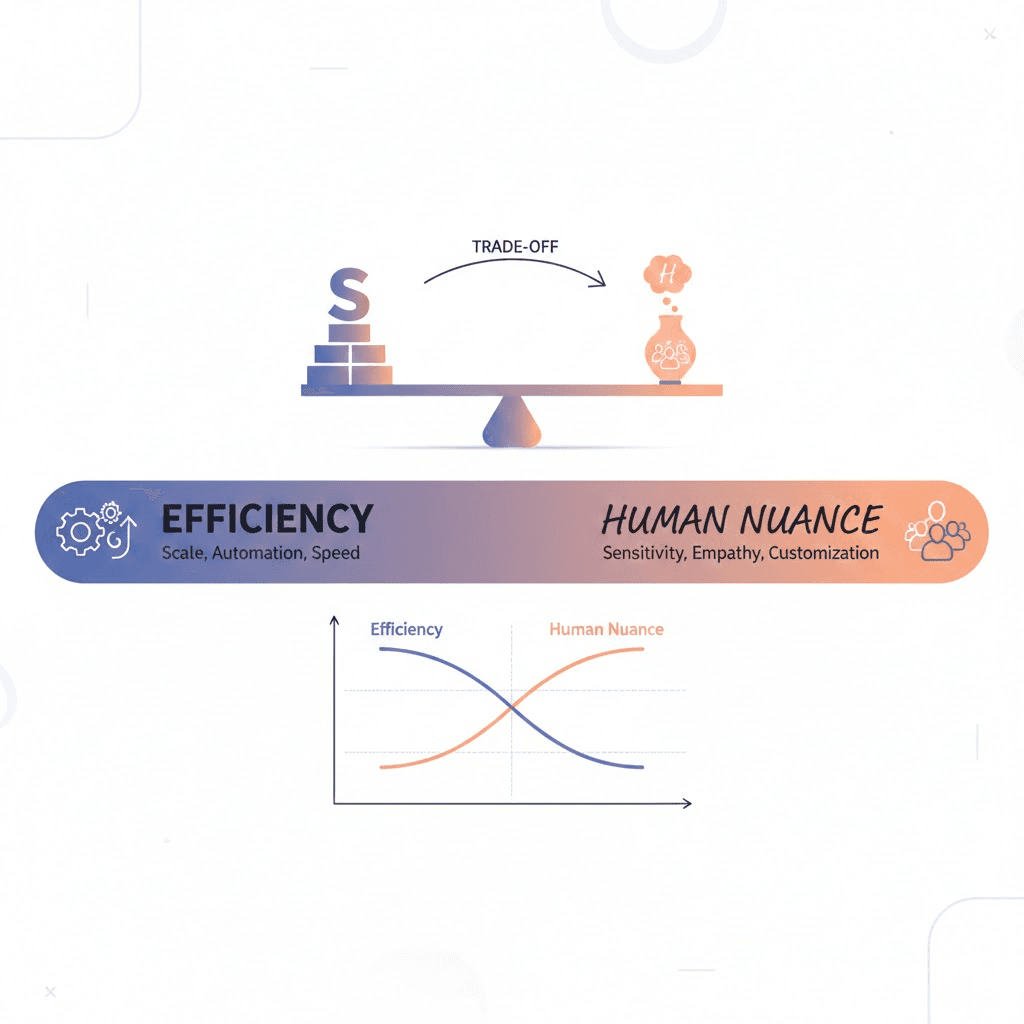
Human Nuance and Empathy
AI systems cannot fully capture the emotional nuance that human interviewers bring to a conversation. They may miss subtle signals in tone, pacing, or body language that often reveal deeper insights about a participant. Cultural context is also difficult for AI to interpret accurately. Small differences in phrasing, humor, or social norms can lead to misunderstandings that a human interviewer would instinctively recognize and adjust for.
Bias and Fairness
Even when designed with care, AI interviewing systems can inherit bias from the data they were trained on. This creates a risk of skewed interpretations or uneven treatment across different groups of people. Transparency is essential. Participants, researchers, and job seekers should understand how the system makes decisions and which factors influence its evaluations. Without clear visibility, trust becomes harder to maintain.
Over Reliance on Automation
There is a danger in leaning too heavily on automated systems. Self reporting biases can still affect interview results, and AI interpretations may not always align with the lived experience of the participant. Human oversight is necessary to catch misinterpretations, challenge assumptions, and ensure that conclusions reflect real human perspectives. In hiring, this becomes even more critical. If AI driven interviews are used without proper regulation, there is potential for misuse or unfair filtering that affects candidates in ways that are hard to detect or contest.
How Anthropic Interviewer Signals the Future of Work
Anthropic Interviewer is more than a research tool. It is a clear signal of how workplaces are evolving as AI becomes an active participant in daily tasks. The system demonstrates what future collaboration may look like and highlights the skills that professionals will need to remain competitive.
Human and AI Collaboration Will Become Standard
The introduction of AI agents that can ask questions, gather information, and analyze responses suggests that many workers will soon manage AI systems the same way they manage coworkers. Instead of replacing people, these tools will operate alongside them and handle structured tasks that require speed and consistency.
As this collaboration becomes normal, oversight and judgment will become essential skills. Professionals will need to understand when AI should be trusted, when human intervention is required, and how to correct errors or misinterpretations. The ability to supervise AI effectively will be as important as knowing how to use it.
Hybrid Roles Will Grow
The workplace is moving toward hybrid roles in which people guide AI workflows rather than completing every task manually. For example, researchers may rely on AI for first pass analysis and then spend their time interpreting results and shaping insights. Recruiters may use AI driven interview screening to organize applicant pools while reserving human time for deeper final stage conversations.
This shift is already visible in many industries that combine automation with human expertise. Anthropic Interviewer shows how these hybrid roles will expand as more AI tools become capable of structured and meaningful interactions.
Employers Will Value AI Fluency
As AI becomes a daily partner in work, employers will prioritize candidates who understand how to use AI responsibly. This means knowing the limits of AI systems, recognizing when outputs need verification, and maintaining accuracy when supervising automated tasks.
AI fluency is not about technical programming skills. It is about practical understanding. Professionals who can combine AI strengths with human judgment will stand out in hiring, promotion, and leadership opportunities. Anthropic Interviewer reinforces the idea that AI awareness is becoming a core part of modern career development.
FAQ
What is Anthropic Interviewer?
Anthropic Interviewer is an AI system created by Anthropic that plans, conducts, and analyzes structured interviews at scale using Claude models. It automates question delivery, adaptive follow ups, and transcript analysis for large research studies.
How does Anthropic Interviewer work?
It uses a three step workflow that includes planning the interview rubric, running ten to fifteen minute interviews, and generating insights through automated analysis of transcripts.
Can AI really conduct meaningful interviews?
AI can conduct structured and consistent interviews, especially when the goal is to gather comparable data across many participants. Humans are still needed for interpreting emotional nuance, evaluating context, and adding judgment.
Will AI interviewing replace human recruiters?
AI interviewing is likely to support recruiters rather than replace them. AI tools may handle early stage screenings and transcripts, while human recruiters will continue to lead final stage conversations and hiring decisions.
Are AI driven interviews fair?
AI can reduce some forms of bias by delivering the same questions to every participant. However, bias can still appear if training data contains patterns that disadvantage certain groups. Human oversight is crucial for fairness.
What concerns do workers have about AI interviews?
Common concerns include job displacement, loss of professional identity, trust in AI decisions, and the accuracy of AI generated insights.
How do creatives use AI in their work?
Creatives often use AI for early drafts, brainstorming sessions, and quick edits. Many still worry about maintaining their personal style and creative identity.
Why are scientists cautious about AI tools?
Scientists prioritize accuracy and reproducibility. They use AI for supporting tasks such as literature reviews and early analysis, but avoid relying on AI for core scientific reasoning.
What skills do candidates need for AI driven interviews?
Candidates should know how to communicate clearly, collaborate with AI tools, validate AI outputs, and adapt to hybrid environments where human and AI systems work together.
How does Interview Sidekick help candidates prepare?
Interview Sidekick simulates AI driven interviews and provides structured, adaptive questioning. This helps job seekers practice responding to AI generated prompts and build confidence for future hiring formats.
Are AI interviews more predictable than human interviews?
Yes. AI systems tend to follow structured question patterns that make the format more consistent. This predictability helps candidates prepare more effectively.
What happens to the interview transcripts?
Transcripts are processed by Claude to identify themes, clusters, sentiment, and insights. Human researchers review these results to ensure accuracy and relevance.
Could AI interviewing be misused in hiring?
If used without oversight, AI driven interviews could lead to unfair filtering or misunderstood responses. Clear regulation and human supervision are necessary to protect candidates.
What should job seekers do to prepare for AI interviews?
Practice with AI based tools, learn how to structure answers, stay concise, and focus on clear reasoning. Getting comfortable with follow up questions is also important since AI systems often adapt in real time.
Conclusion
Anthropic Interviewer shows how quickly the world of interviewing and workplace research is evolving. By combining structured questioning, real time adaptation, and automated analysis, the system demonstrates what AI can accomplish when it supports human decision making rather than replacing it. The first wave of interviews reveals a workforce that is hopeful about the benefits of AI while still cautious about trust, identity, and long term career impact.
This shift matters for everyone. Researchers gain new ways to understand human behavior at scale. Companies gain faster and more consistent tools for early stage hiring. Job seekers gain insight into how future interviews may look and how they can prepare. AI becomes a partner that handles structure and speed while humans bring judgment, empathy, and meaning.
The message is clear. The future of interviewing will be hybrid. Candidates who know how to communicate with AI systems, validate AI outputs, and navigate structured questioning will have a real advantage. Platforms like Interview Sidekick help bridge that gap by offering practical experience with AI driven interview formats.
Anthropic Interviewer is not just a research tool. It is a sign of where work is heading and a reminder that preparation, adaptability, and AI fluency will define the next generation of professional success.