Best AI Interview Question Generators in 2026
 Rishabh Jain5 min read
On this page
- TL;DR
- Why AI Interview Question Generators Matter in…
- What Makes a Good AI Interview Question Genera…
- Best AI Interview Question Generators Comparison
- Best AI Interview Question Generator in 2026
- AI Interview Question Generators vs Interview…
- Who Should Use Interview Question Generators?
- How to Choose the Right AI Interview Question…
- FAQ
- Conclusion
TL;DR
Interview preparation in 2026 is less about guessing and more about practicing the right questions. The best AI interview question generators help job seekers understand the most likely questions they will be asked, based on role, job description, skills, and experience level. These tools make it easier to prepare systematically instead of relying on generic interview lists.
This guide reviews the best AI interview question generators in 2026 from a job seeker’s perspective. We compare tools that generate probable interview questions for technical roles, product roles, design positions, sales interviews, and behavioral rounds. You’ll find options that work directly from job descriptions, tools focused on interview prep, and free generators useful for early-stage practice.
If you want a quick breakdown:
Interview Sidekick helps candidates generate role-specific and behavioral questions they are likely to face, making it useful for structured interview preparation.
Recooty, Workable, and Talent HR offer recruiter-style question sets that job seekers can use to understand how interviews are structured.
Eztrackr, GoHire, and Wisedoc provide simple ways to generate common and role-based interview questions for practice.
NodeFlair and Skillora are especially helpful for technical and skill-focused interview questions.
Voila works well for quick question drafts and last-minute preparation.
Use this guide to identify the types of questions interviewers are likely to ask for your role, practice them in advance, and walk into interviews better prepared and more confident.
Why AI Interview Question Generators Matter in 2026
Preparing for interviews in 2026 is no longer about memorizing generic questions or relying on outdated lists. Interviews have become more structured, role-specific, and closely tied to job descriptions. As a result, job seekers are increasingly using AI interview question generators to understand the kinds of questions they are most likely to face and to prepare more intentionally.
From a job seeker’s perspective, the biggest challenge is uncertainty. Candidates often wonder which questions actually matter, how deep interviewers will go, and what topics they should prioritize. Question generators help reduce that guesswork by producing probable interview questions based on role, skills, seniority, and responsibilities. This allows candidates to practice the right questions instead of trying to prepare for everything.
These tools are also useful because they reflect how interviews are designed today. Hiring managers and recruiters rely on structured question sets to ensure consistency and fairness across candidates, often discussed in hiring teams that set up a recurring webinar to align interview standards. When job seekers practice using similar question frameworks, they gain insight into how interviews are evaluated and what interviewers are listening for.
Another reason these tools matter in 2026 is speed. Job searches move quickly, and candidates often apply to multiple roles at once. AI interview question generators make it easier to adapt preparation for each position by generating questions directly from job descriptions, saving time while improving relevance.
In short:
AI interview question generators are tools that help job seekers identify and prepare for likely interview questions based on role requirements, skills, and job descriptions.
Used correctly, these tools do not replace thoughtful preparation. Instead, they help candidates focus their effort, practice with intention, and walk into interviews feeling more confident and better prepared.
What Makes a Good AI Interview Question Generator?
A good AI interview question generator helps job seekers prepare for the questions they are most likely to face, not just produce random prompts. The best tools in 2026 focus on relevance, realism, and structure so candidates can prepare with intention rather than guesswork.
Core Qualities
Job description awareness
Strong generators use the job description as their starting point. This allows them to surface interview questions that reflect the actual responsibilities, skills, and expectations of the role, which is exactly how most interviews are designed today.
Role and seniority specificity
Questions should change based on seniority. Entry-level roles focus more on fundamentals and learning ability, while senior roles test decision-making, ownership, and leadership. A good generator adjusts question depth accordingly.
Behavioral and technical coverage
Most interviews include both behavioral and role-specific questions. Effective tools generate a balanced mix so job seekers can practice storytelling, problem-solving, and role-relevant thinking in one place.
Clear difficulty levels
A useful generator separates basic, intermediate, and advanced questions. This helps candidates prepare progressively instead of jumping straight into overly complex scenarios.
Industry relevance
Questions should reflect the norms of the industry. Interviews in tech, product, sales, design, or operations all sound different. Industry-aware tools help candidates practice questions that feel realistic for their field.
Customization and filtering
The ability to filter questions by role, skill, difficulty, or interview type makes preparation far more efficient. Customization helps job seekers focus on what matters most for each interview.
Use cases for hiring vs preparation
The best tools work for both sides. Hiring teams use them to structure interviews, while job seekers use the same questions to understand how interviews are framed and evaluated. This overlap helps candidates prepare more strategically.
Best AI Interview Question Generators Comparison
Tool | Free version | Best for | Job description input | Behavioral questions | Technical questions | Role coverage | Seniority levels | Customization depth | Ease of use | Pricing |
|---|---|---|---|---|---|---|---|---|---|---|
Interview Sidekick | Yes (page is labeled “Free”) | Job seekers who want JD-based, role- and level-based question sets | Yes (required) | Not explicitly stated (question type is selectable, but options not shown on page) | Not explicitly stated (question type selectable) | Job title selector + optional company field | Yes (explicit field) | High (job title, seniority, question type, company optional, # questions) | Simple form | Free (tool page) |
Recooty | Not verifiable (bot check) | Not verifiable | Not verifiable | Not verifiable | Not verifiable | Not verifiable | Not verifiable | Not verifiable | Not verifiable | Not verifiable |
Eztrackr | Yes (“Free AI Interview Question Generator”) | Job seekers generating likely questions from a posting | Yes (required) | Yes (explicitly says it generates a mix including behavioral) | Yes (explicitly says it generates a mix including technical) | “Wide range of positions and industries” (per FAQ) | Not mentioned | Medium (company, position, JD fields) | Simple form | Free tool page (sign-up optional for broader platform) |
GoHire | Yes (“Free Interview Question Generator”) | Hiring teams generating a quick interview question list from a role title | No JD field shown (tool instructions mention filling “details” and shows “Job Title”) | Not explicitly stated | Not explicitly stated | Broad (any job title) | Not mentioned | Low (appears mainly role title driven) | Very simple | Free tool page |
TalentHR | Yes (page says “100% Free, No Login Needed”) | Hiring teams creating interview questions by role, industry, seniority, and tone | No (fields shown: job position, industry, seniority, tone) | Not explicitly stated | Not explicitly stated | Broad (role + industry) | Yes (explicit field) | Medium (position, industry, seniority, tone) | Simple form | Generator page is free; TalentHR product mentions paid plan “$2/user” |
Workable | Yes (“FREE Interview Kit Generator”) | Hiring teams generating interview questions by position (optionally industry and tone) | No (instructions: type position; industry optional; tone optional) | Not explicitly stated | Not explicitly stated | Broad (any industry/position) | Not mentioned | Medium (position + optional industry + optional tone) | Simple form | Free tool page |
Voilà | Yes (Free plan available) | Job seekers who want a quick prompt-based list and tone/language control | Prompt box (up to 1,000 chars); not labeled “job description,” but you can paste context | Not explicitly stated | Not explicitly stated | Broad (depends on prompt) | Not mentioned | Medium (language + tone + free-text prompt) | Very simple | Free plan ($0) + Premium/Ultimate tiers |
NodeFlair | Yes (explicitly “100% Free” and “no account needed”) | Job seekers who want questions tailored to resume + JD, plus guidance | Yes (explicit JD paste + resume upload) | Yes (explicitly includes behavioural) | Yes (explicitly includes technical) | Role + JD based; positioned for job seekers | Not mentioned | High (resume + JD; also provides importance/framework/sample answer) | Slightly more steps (upload + paste) | Free |
Skillora | Not verifiable (page returned no readable content) | Not verifiable | Not verifiable | Not verifiable | Not verifiable | Not verifiable | Not verifiable | Not verifiable | Not verifiable | Not verifiable |
Wisedoc | Free trial + paid plans | Job seekers who want job-tailored questions + difficulty progression | Yes (job description + resume) | Yes (explicitly includes behavioral) | Yes (explicitly includes technical challenges) | “All key segments” and job-tailored | Not stated as “seniority,” but has easy/medium/hard difficulty levels | High (job-tailored + multi difficulty levels) | Moderate | Monthly Premium $14.95; 3-month premium $34.95; free trial option listed |
Best AI Interview Question Generator in 2026
1. Interview Sidekick
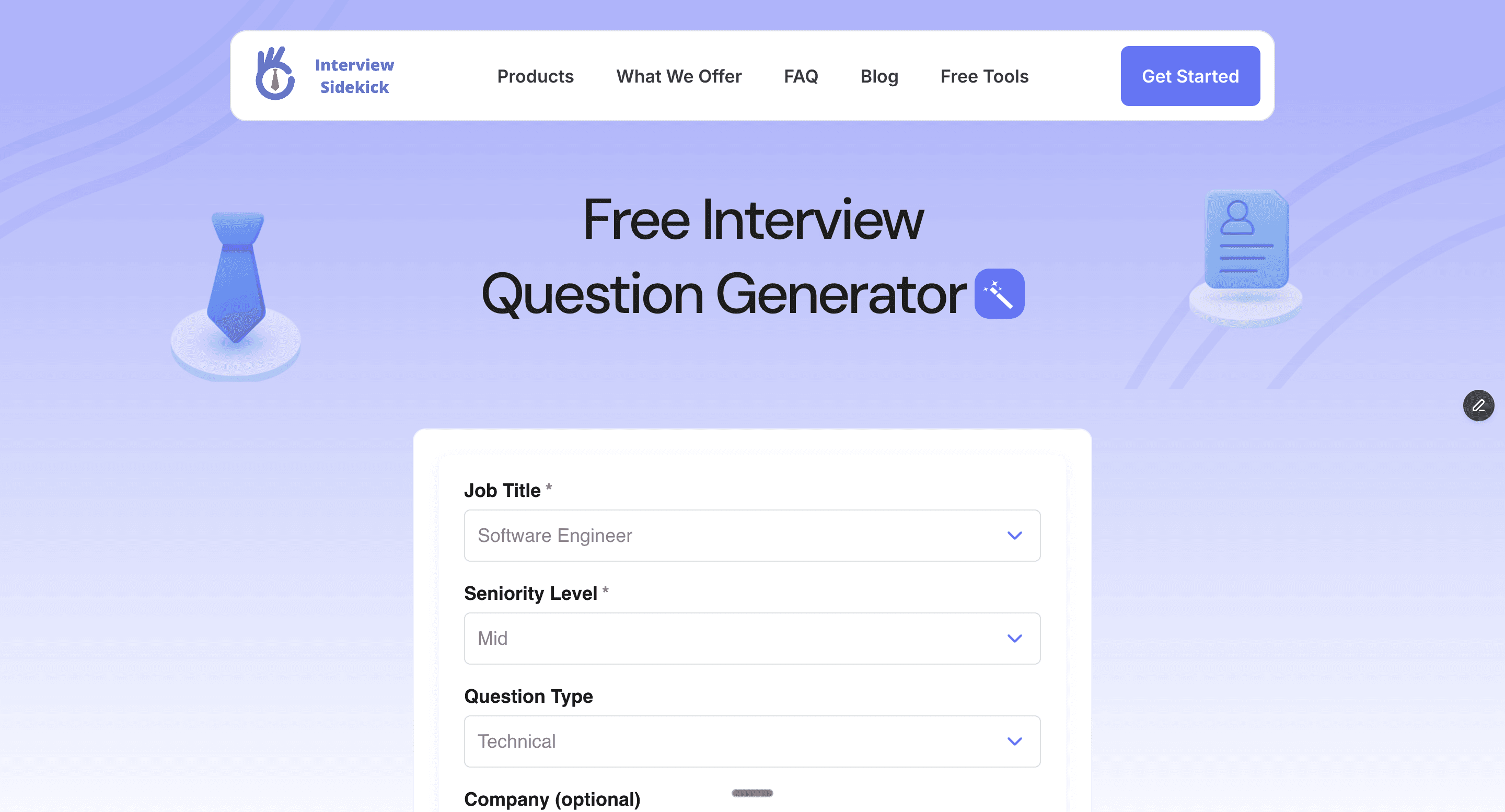
Generated questions:
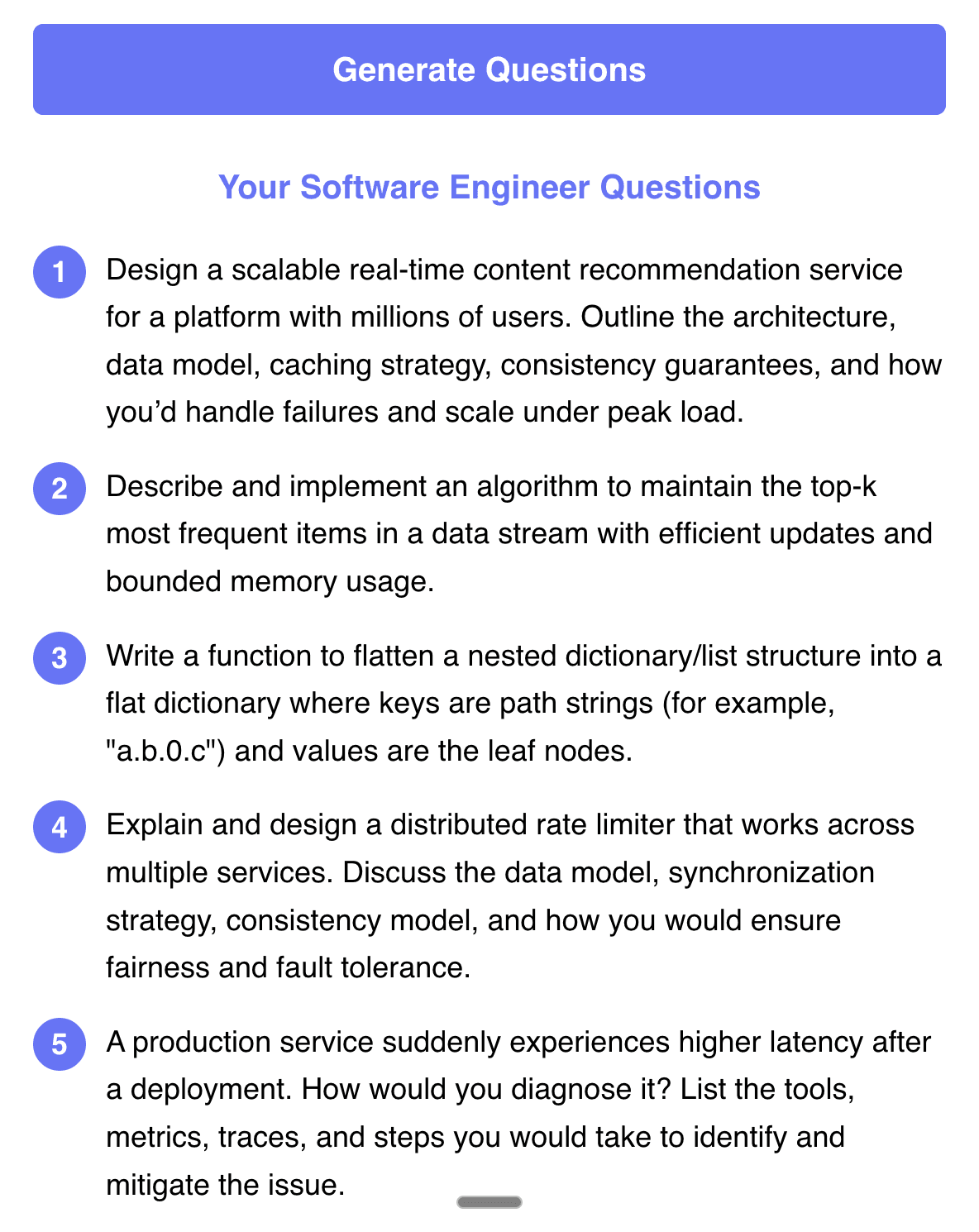
What it does
Interview Sidekick generates interview questions based on role, seniority, and job description, making it useful for structured interview preparation and realistic practice.
Best for
Job seekers who want role-specific and behavioral interview questions that closely reflect how real interviews are designed.
Strengths
Strong role-specific and behavioral question coverage
Supports seniority-based question depth
Useful for preparing both behavioral and role-relevant answers
Reflects how structured interviews are typically run
Limitations
Works best when users actively practice answering the questions, not just reading them
Who should choose it
Candidates who want to prepare using realistic, interviewer-style questions rather than generic lists.
Pull-out insight: Practicing realistic questions helps answers feel more natural in live interviews.
2. Recooty
Generated questions:
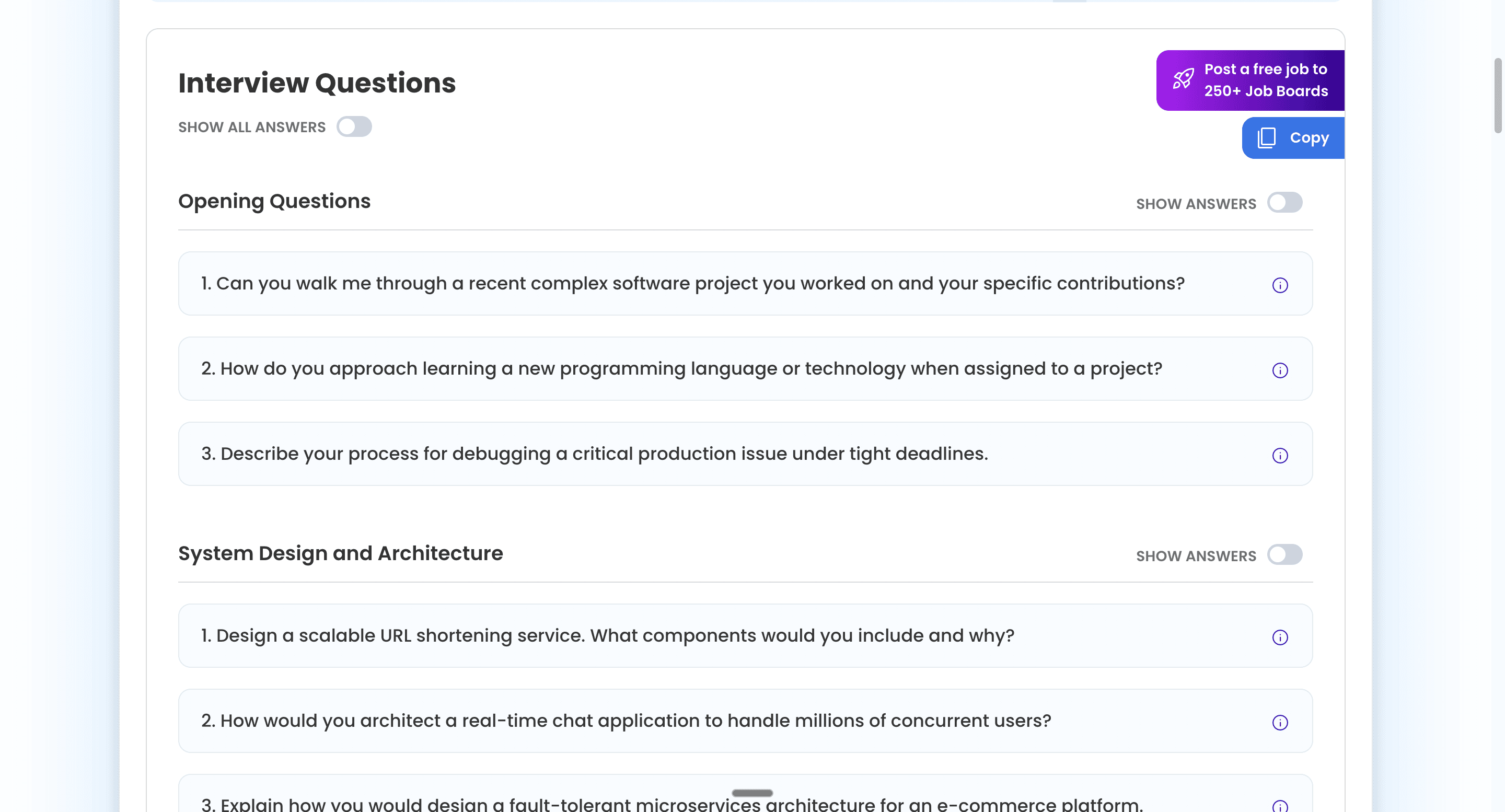
What it does
Recooty generates interview questions designed mainly for hiring workflows and recruiter use.
Best for
Job seekers who want to understand how recruiters structure interviews and screen candidates.
Strengths
Recruiter-oriented question framing
Useful for understanding interviewer expectations
Covers common role-based questions
Limitations
Less focused on candidate-side preparation
Limited customization for practice scenarios
Who should choose it
Candidates who want insight into recruiter-style interview questions.
Pull-out insight: Recruiter tools often reveal how interviews are standardized.
3. Eztrackr
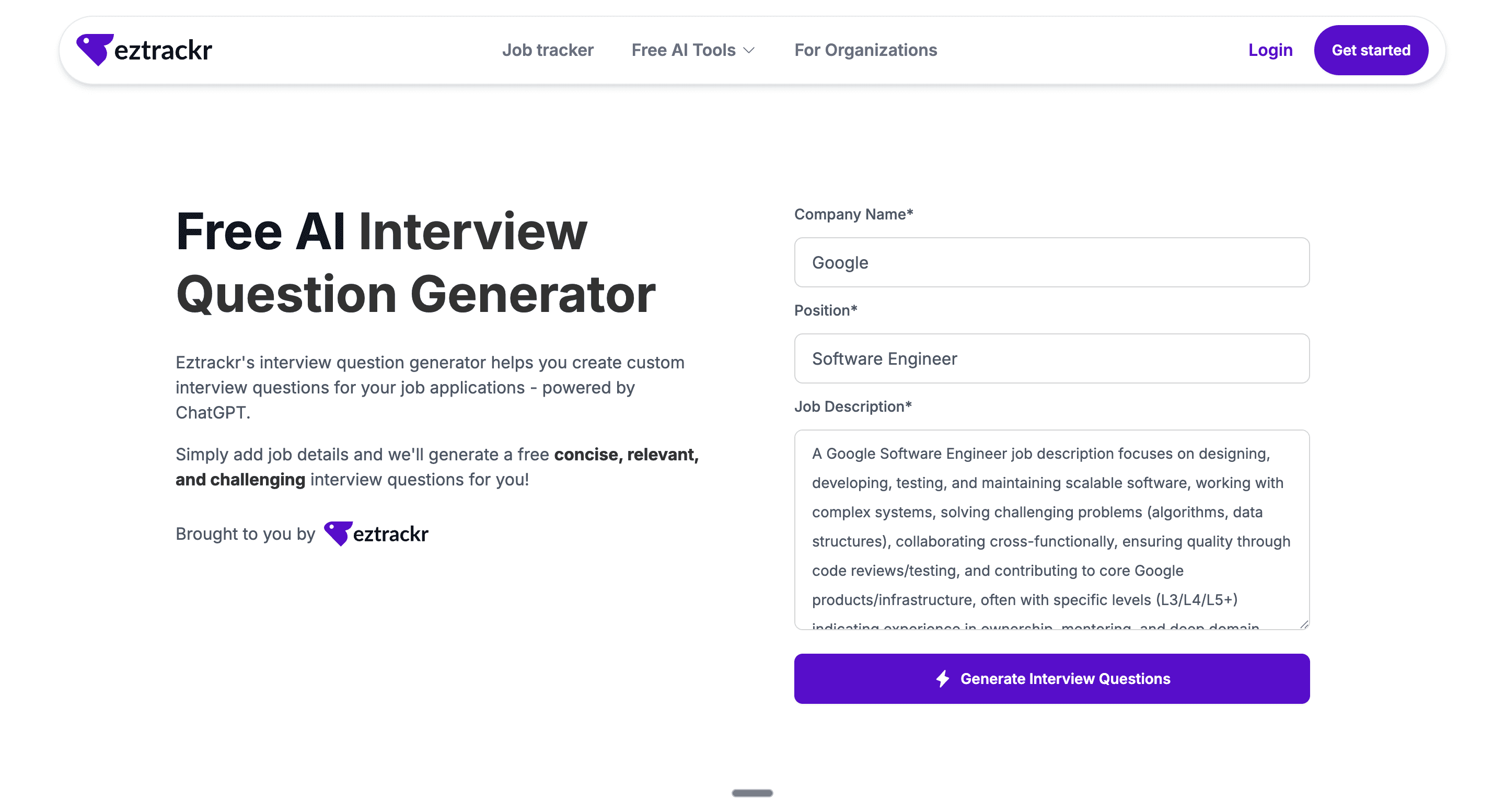
Generated questions:
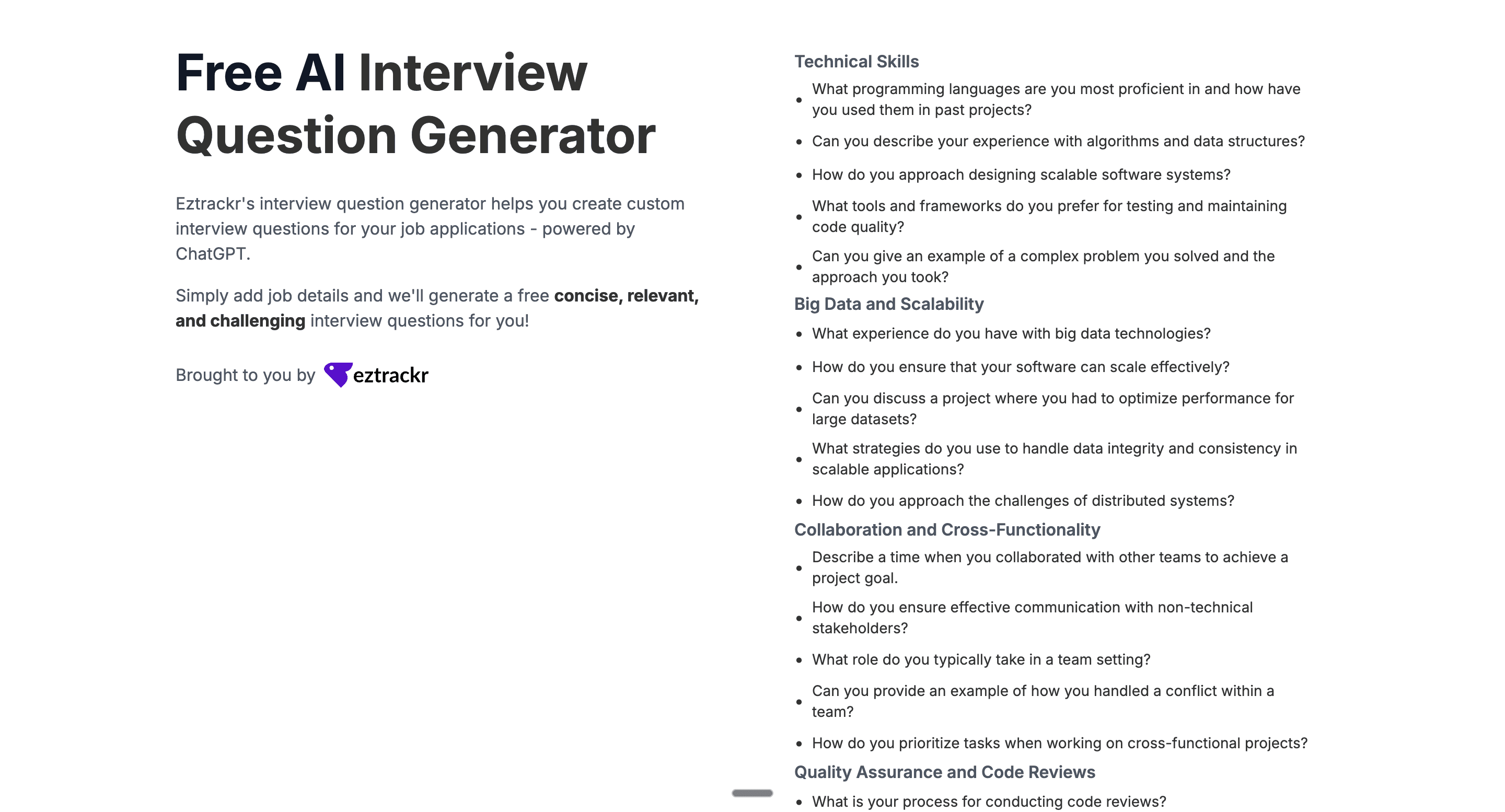
What it does
Eztrackr generates interview questions tied to job descriptions and preparation workflows.
Best for
Job seekers preparing for interviews role by role.
Strengths
Simple and easy to use
Job-description-based question generation
Suitable for structured preparation
Limitations
Focuses on question generation rather than interview simulation
Who should choose it
Candidates who want a straightforward way to identify likely interview questions.
Pull-out insight: Focused preparation beats memorizing generic questions.
4. GoHire
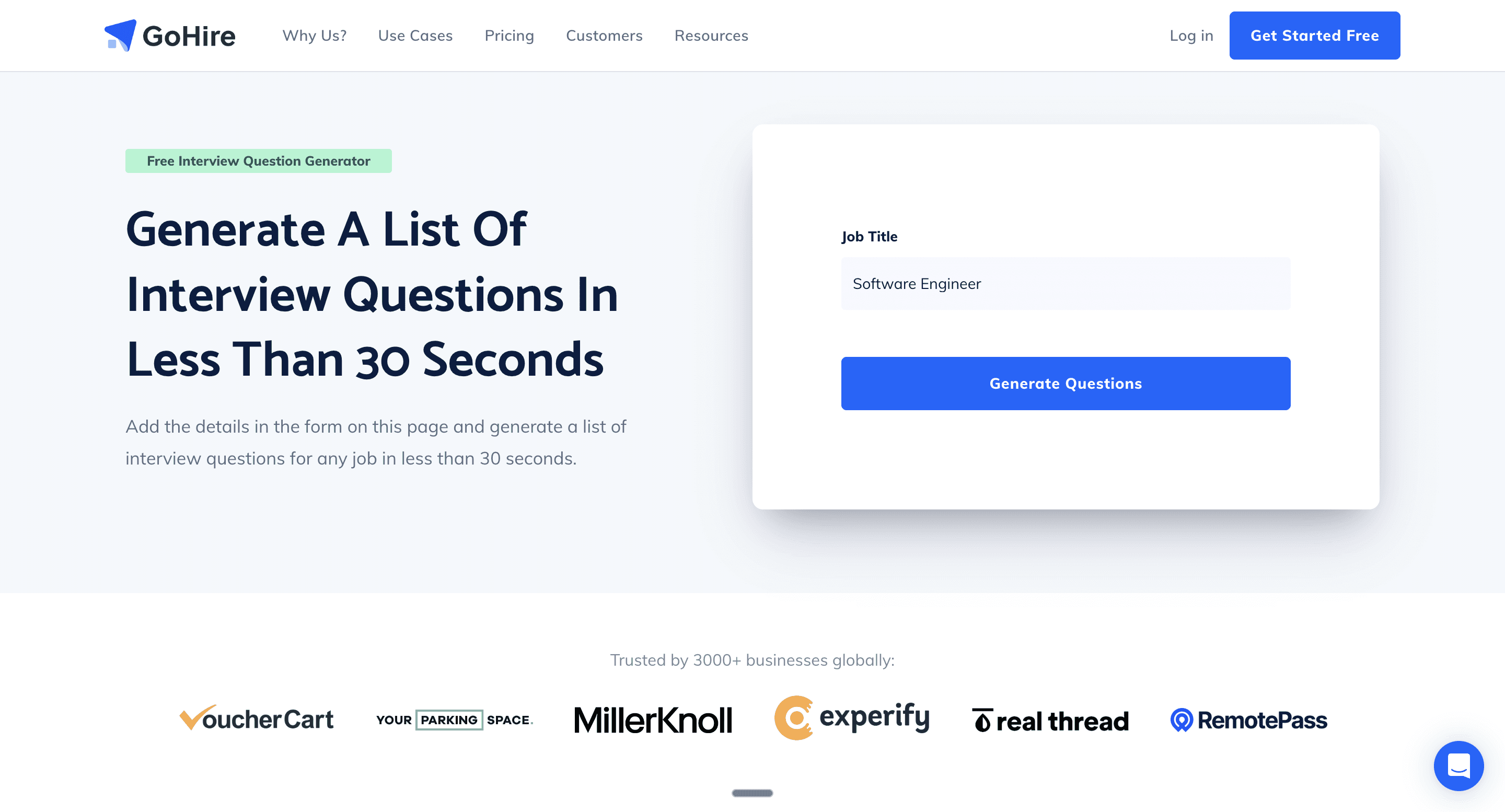
Generated questions (it hung, I tried many times but it didn't work):
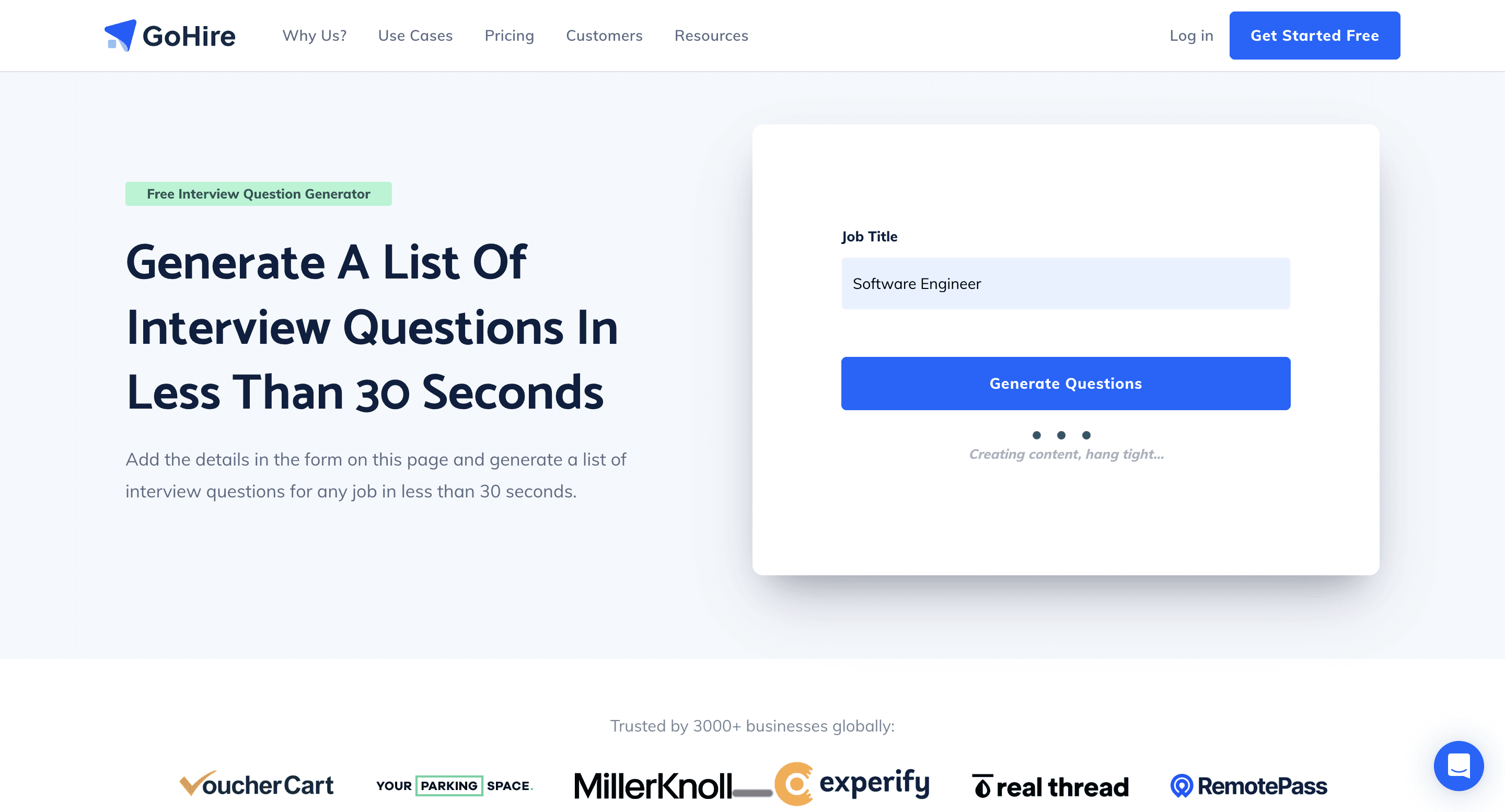
What it does
GoHire offers a free interview question generator primarily aimed at hiring teams.
Best for
Job seekers looking for common interview questions across standard roles.
Strengths
Free and fast
Covers many common roles
Easy to access
Limitations
Limited depth and customization
Less tailored to senior or niche roles
Who should choose it
Candidates in early-stage preparation or applying for common positions.
Pull-out insight: Free tools are useful starting points, not final preparation.
5. Talent HR
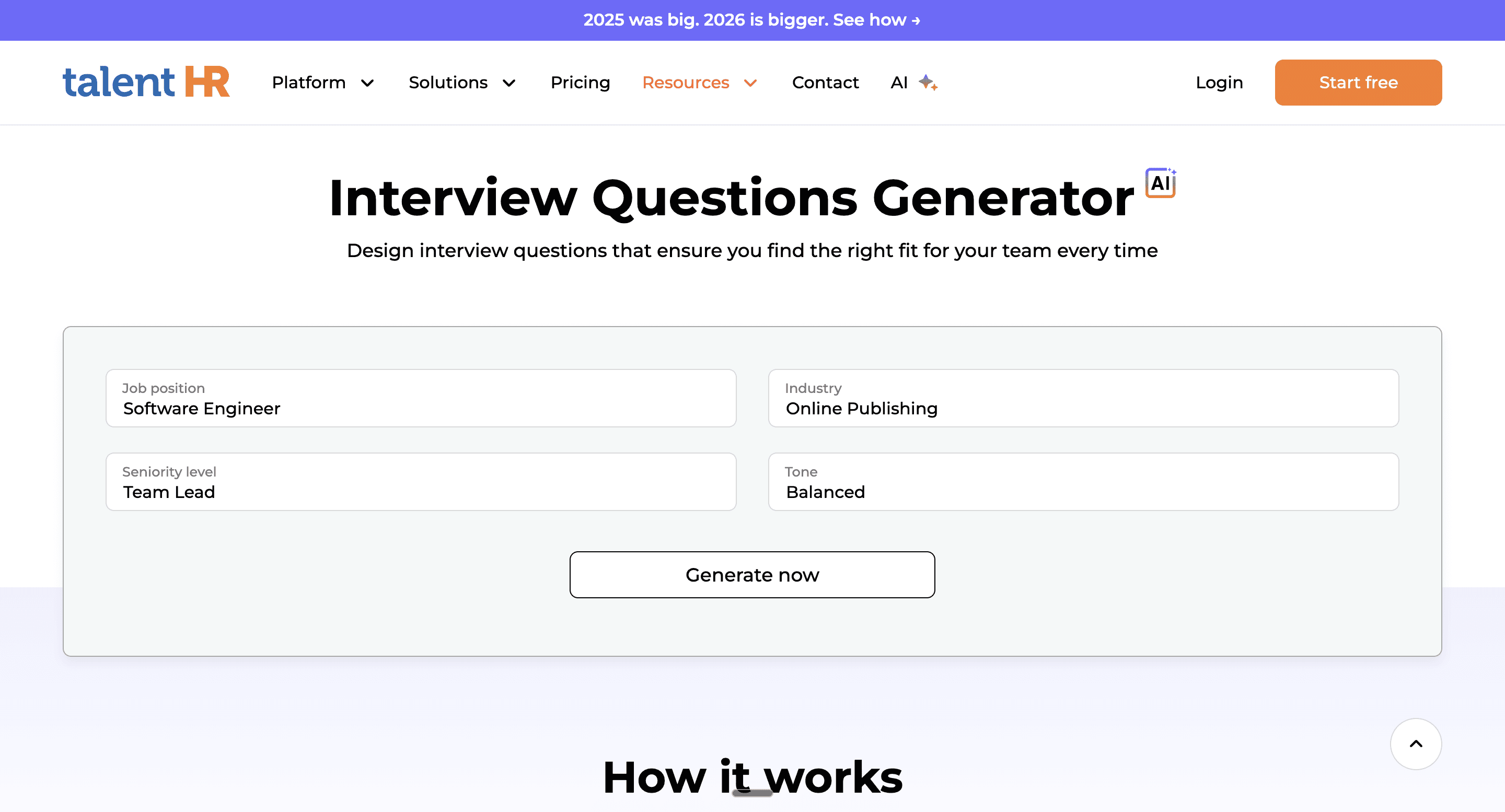
Generated questions:
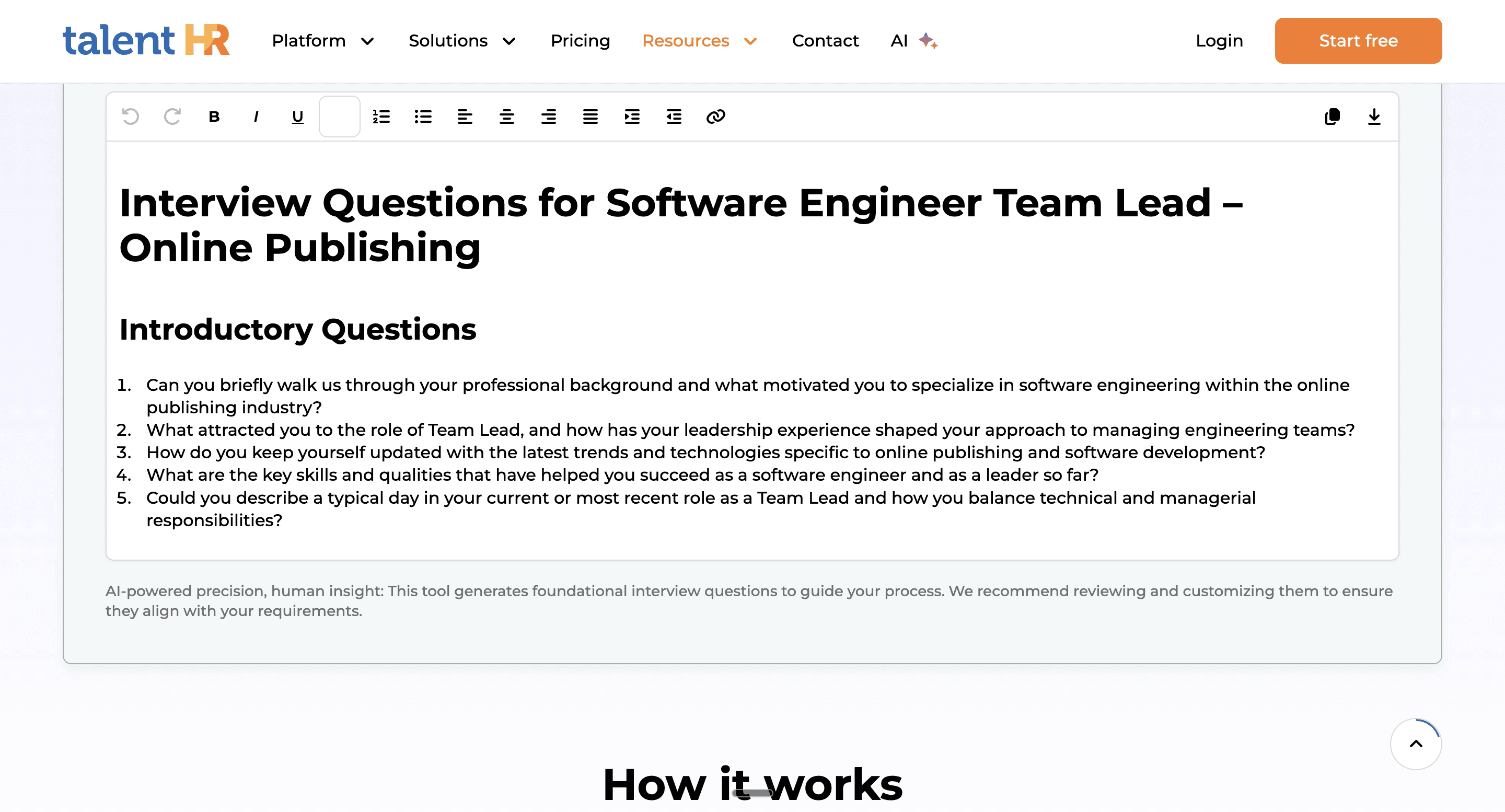
What it does
Talent HR generates interview questions with a focus on behavioral and culture-fit evaluation.
Best for
Job seekers preparing for HR and behavioral interview rounds.
Strengths
Strong behavioral question focus
Reflects culture-fit evaluation styles
Easy to use
Limitations
Limited technical depth
More HR-centric than role-specific
Who should choose it
Candidates who want to prepare for behavioral and people-focused interviews.
Pull-out insight: Behavioral rounds often matter more than technical ones.
6. Workable
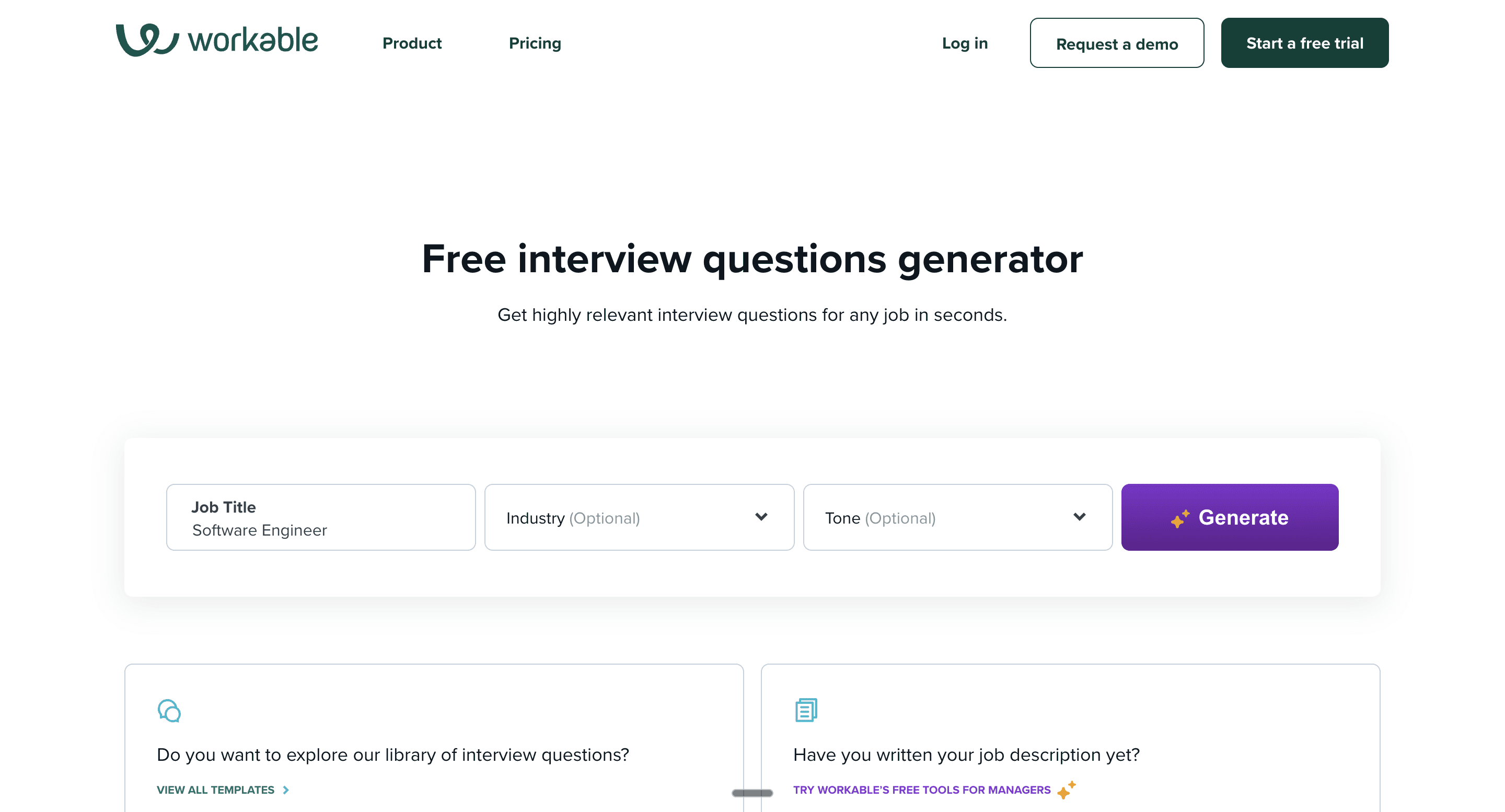
Generated questions:
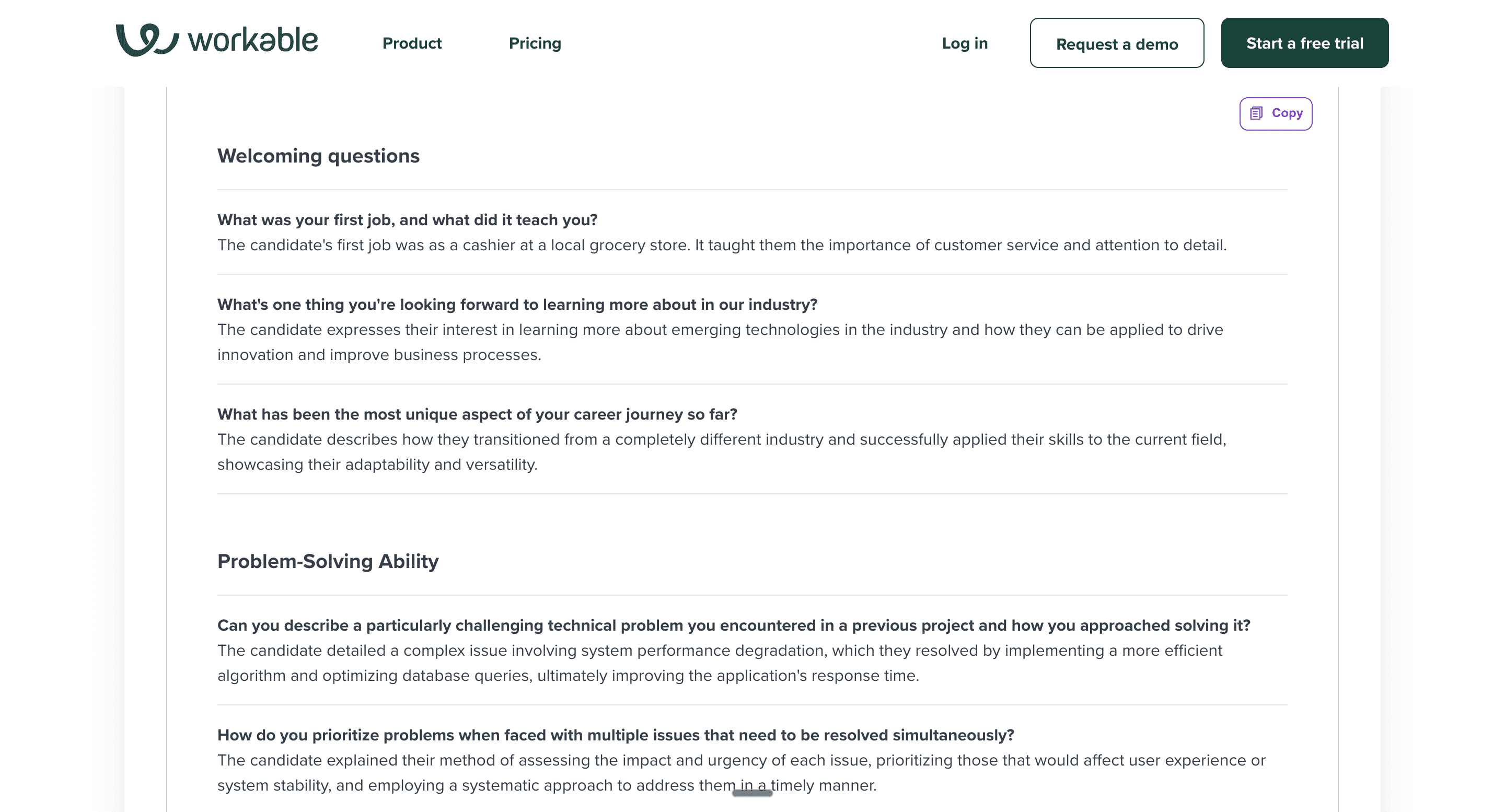
What it does
Workable provides structured interview questions used widely by hiring teams.
Best for
Job seekers who want to practice questions commonly used by recruiters.
Strengths
Large question library
Covers many roles and industries
Structured interview approach
Limitations
Less tailored to individual job descriptions
Limited customization for preparation
Who should choose it
Candidates who want exposure to standard recruiter-approved questions.
Pull-out insight: Many companies rely on structured interview kits.
7. Voila
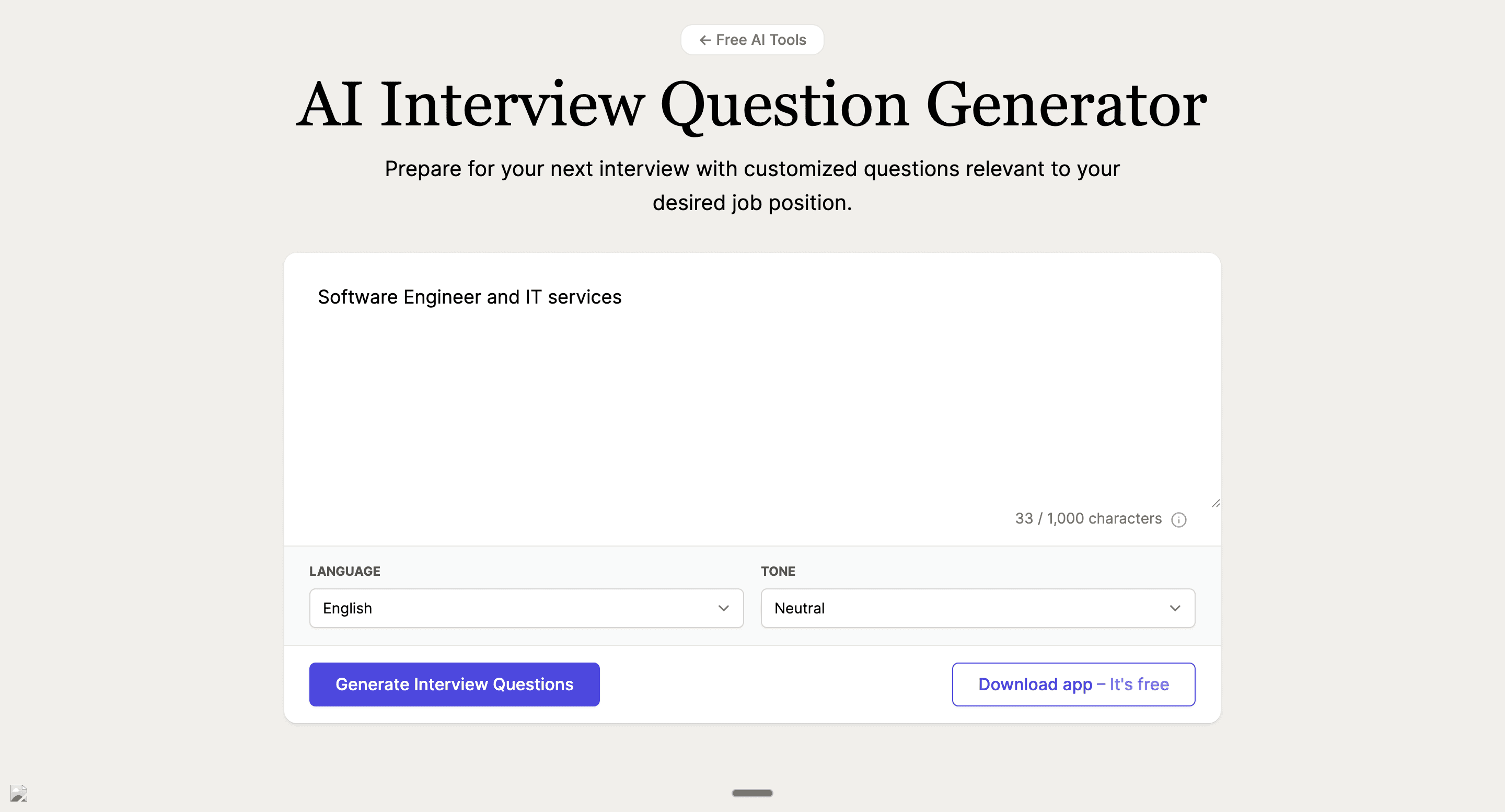
Generated questions:
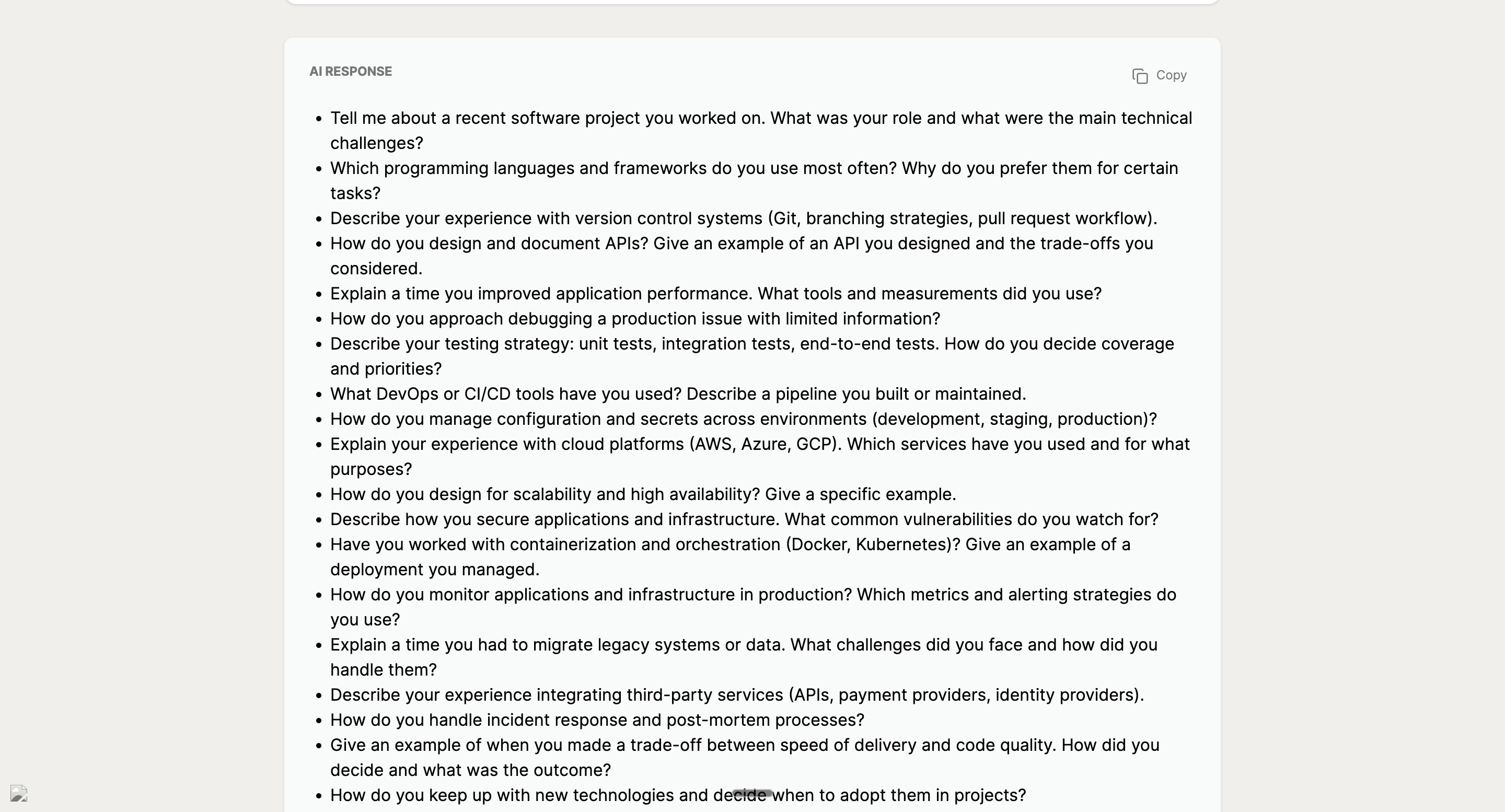
What it does
Voila generates interview questions based on user prompts and quick inputs.
Best for
Quick question drafts and last-minute preparation.
Strengths
Fast and lightweight
Flexible prompt-based generation
Low friction to use
Limitations
Requires good prompts for best results
Less structured than role-specific tools
Who should choose it
Candidates who want fast question generation without setup.
Pull-out insight: Prompt quality directly affects output quality.
8. NodeFlair
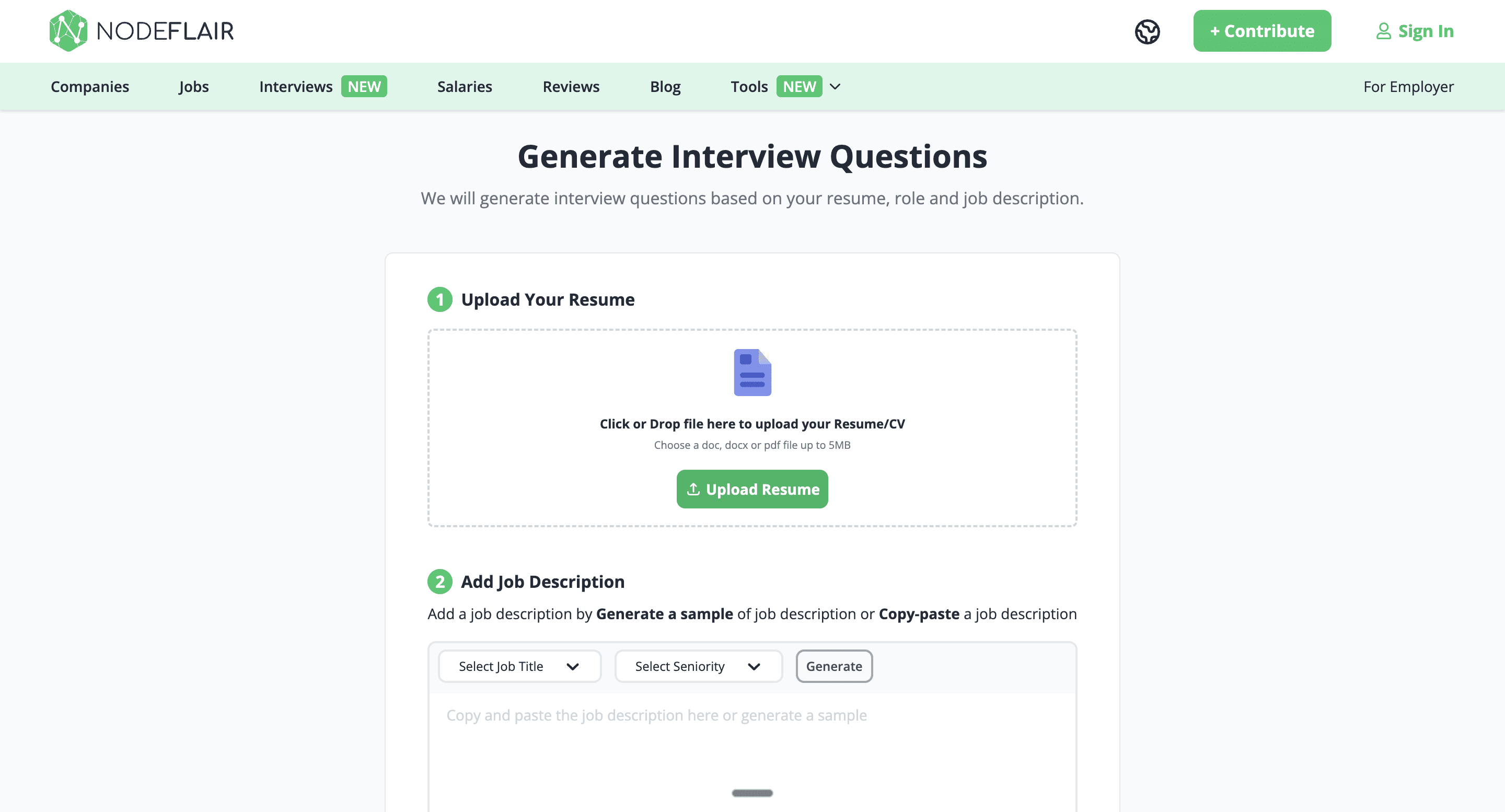
Generated questions:
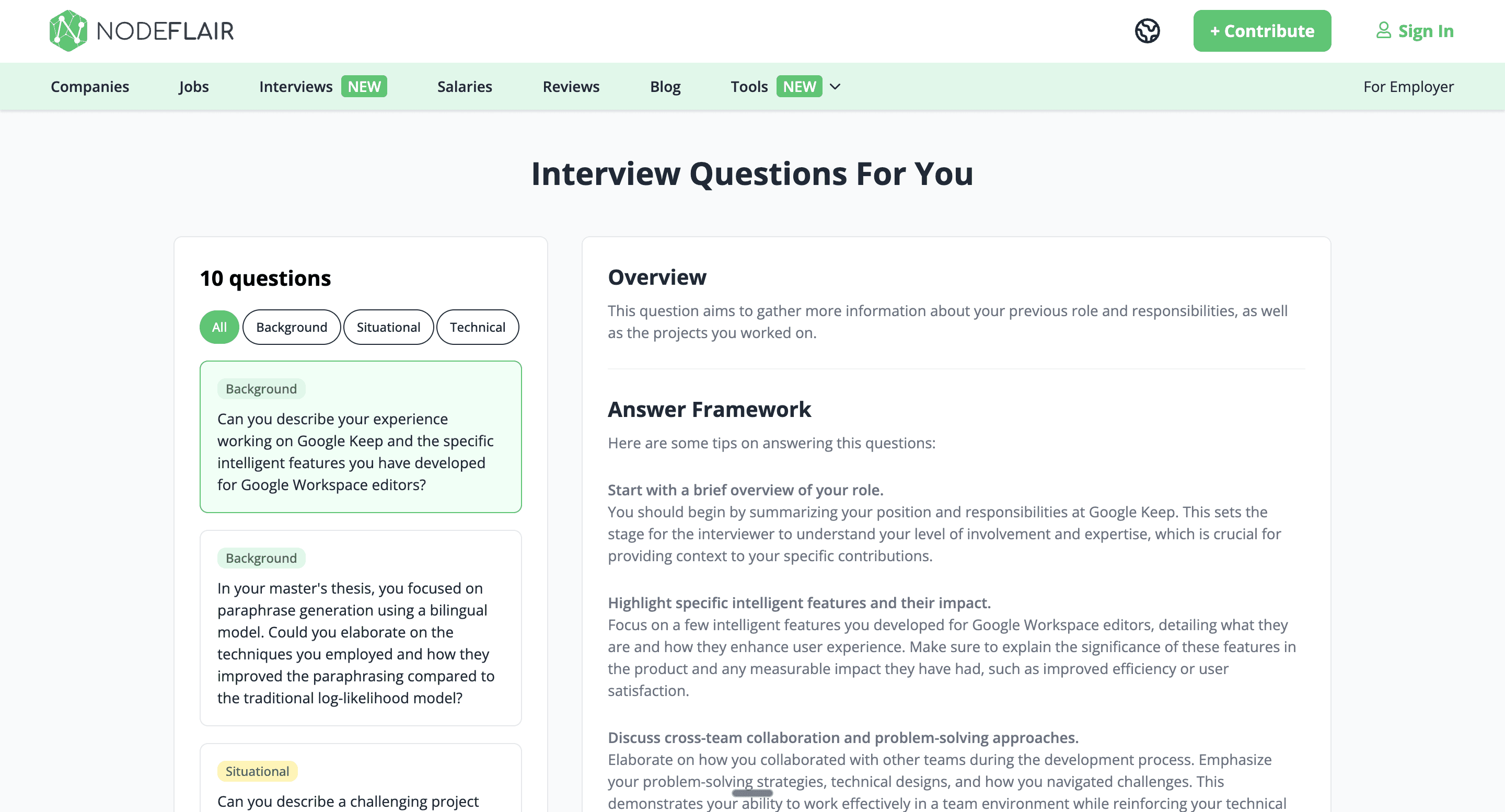
What it does
NodeFlair generates interview questions tailored to resumes and job descriptions, with a focus on technical roles.
Best for
Software engineers and technical candidates.
Strengths
Strong technical relevance
Resume and job-description-driven questions
Suitable for developer interviews
Limitations
Less relevant for non-technical roles
Who should choose it
Candidates preparing for engineering or developer interviews.
Pull-out insight: Technical interviews test thinking, not memorization.
9. Skillora
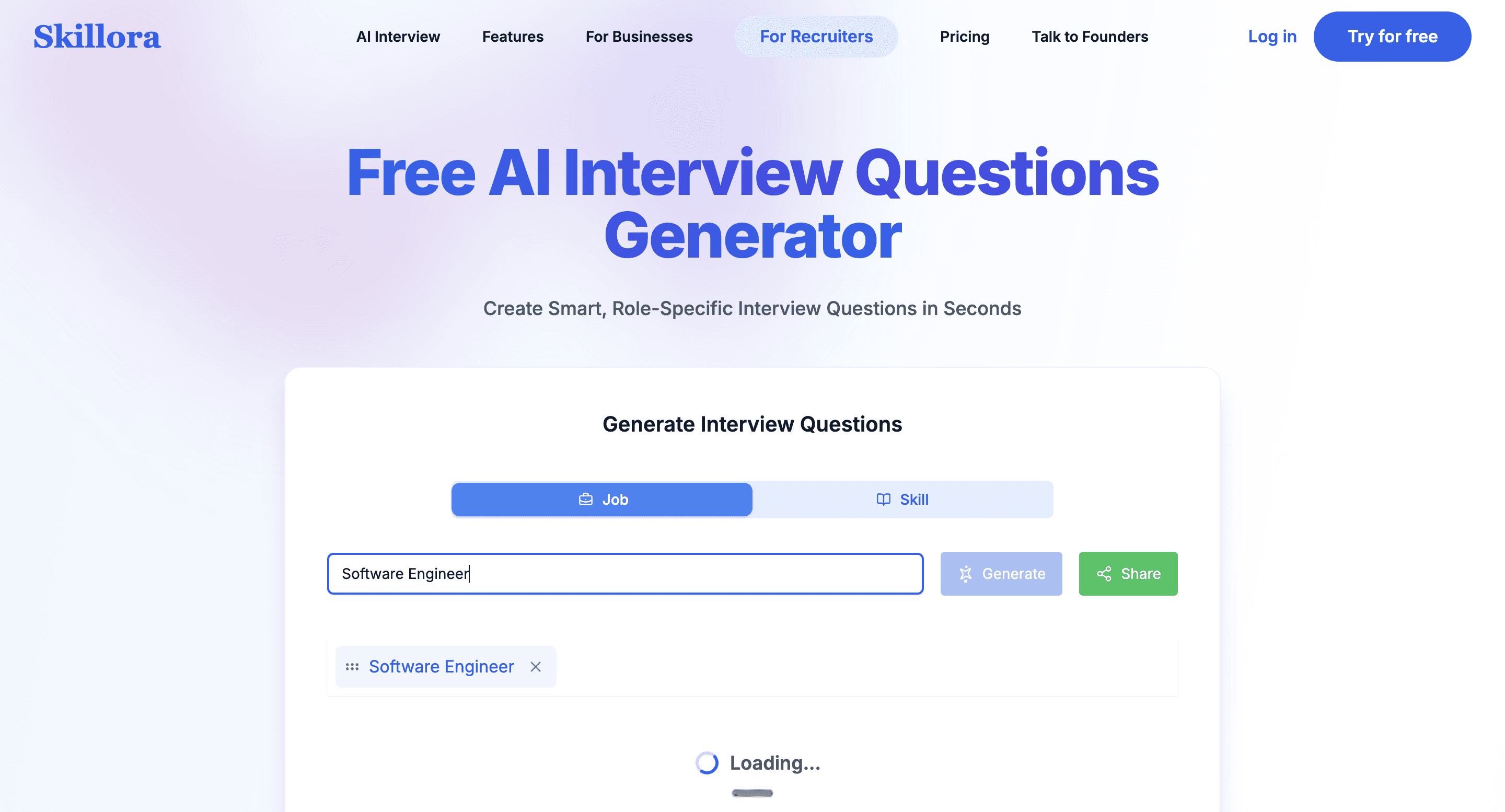
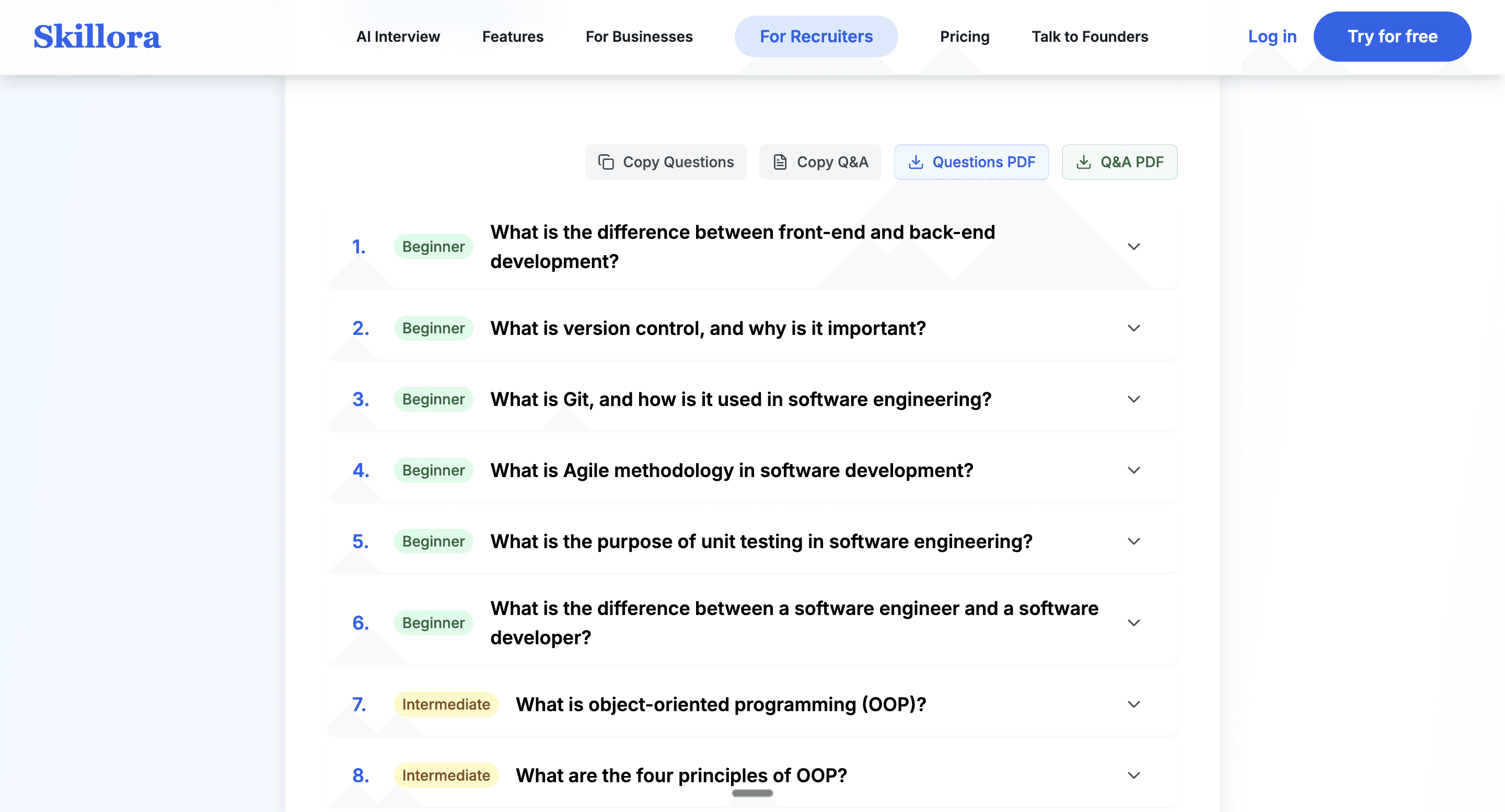
Generated questions:
What it does
Skillora generates skill-based interview questions for assessments and preparation.
Best for
Candidates who want to practice skill-focused questions.
Strengths
Skill-based approach
Useful for assessments and prep
Clear question focus
Limitations
Less emphasis on behavioral storytelling
Who should choose it
Candidates preparing for skill validation rounds.
Pull-out insight: Skill clarity matters as much as experience.
10. Wisedoc
What it does
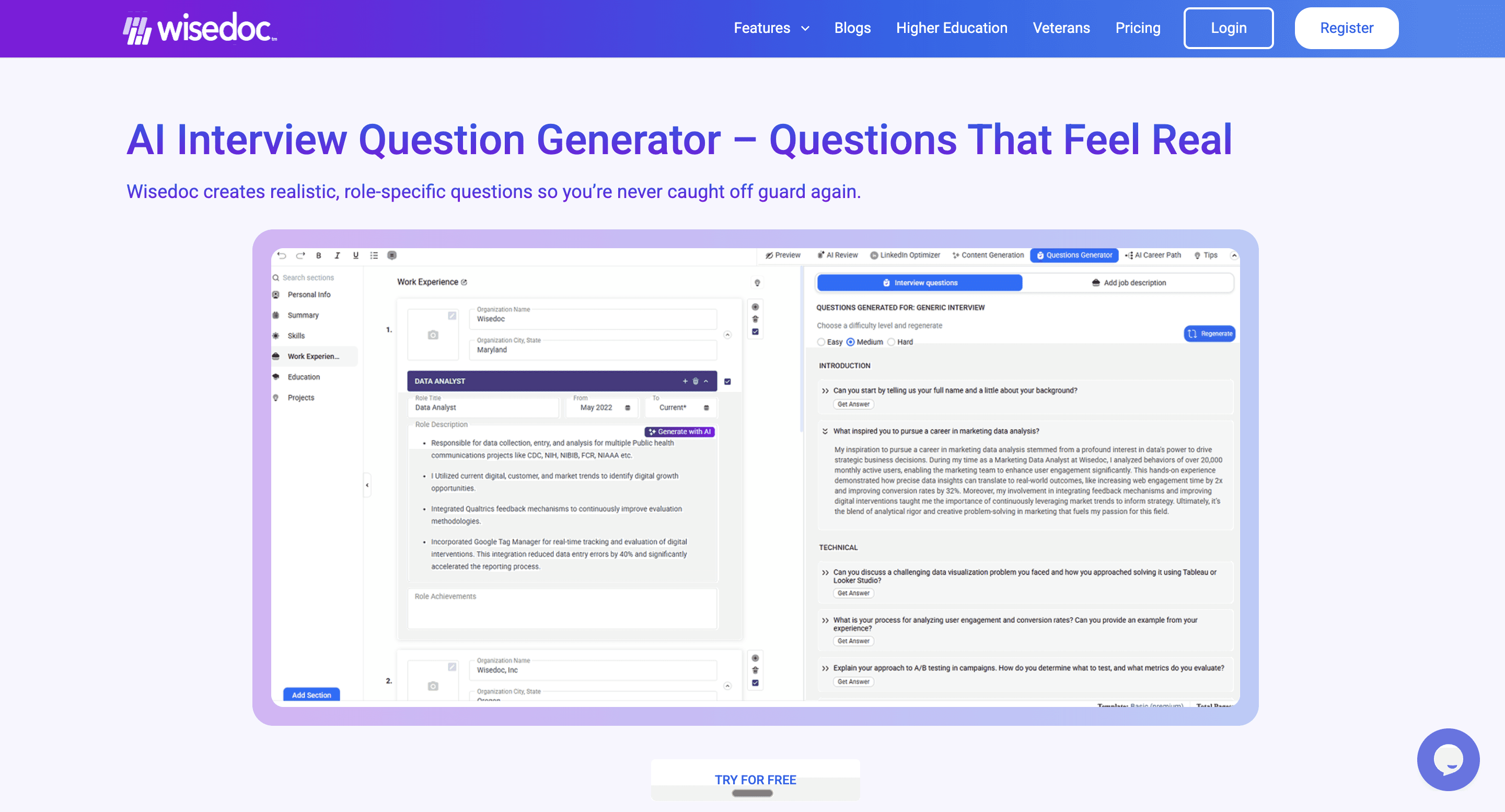
Wisedoc generates general interview questions with an emphasis on behavioral and basic role coverage.
Best for
Early-stage preparation and behavioral interviews.
Strengths
Simple and accessible
Covers common interview scenarios
Useful for practice and confidence building
Limitations
Limited advanced or niche role coverage
Who should choose it
Freshers and candidates starting interview preparation.
Pull-out insight:
Strong basics set the foundation for good interviews.
AI Interview Question Generators vs Interview Practice Tools
AI interview question generators and interview practice tools serve different purposes in interview preparation. Understanding how they differ helps job seekers use each one at the right stage of preparation.
Question creation vs interview simulation
AI interview question generators focus on what you might be asked. They help job seekers identify likely interview questions based on role, skills, job descriptions, and experience level. This is especially useful when preparing for new roles or unfamiliar interview formats.
Interview practice tools focus on how you respond. They simulate interview conversations, helping candidates practice answering questions out loud, handling follow-ups, and maintaining clarity under pressure.
When each is most useful
Question generators are most helpful early in preparation. They help you map the interview landscape, identify key topics, and decide what stories or examples you need to prepare.
Interview practice tools are most useful once you know the questions. They help you practice delivery, improve confidence, and learn to think clearly during live conversations.
Why combining both leads to better interviews
Job seekers who use both tools often perform better in interviews. Question generators help you prepare the right material, while practice tools help you deliver that material naturally.
By first identifying probable questions and then practicing answering them in realistic scenarios, you reduce surprises and improve clarity. This combination leads to interviews that feel more confident, structured, and conversational.
Who Should Use Interview Question Generators?
Interview question generators are often marketed to recruiters, but in practice, job seekers gain just as much value from understanding how interviews are designed. Knowing the questions interviewers are likely to ask gives candidates a clear preparation advantage.
Recruiters and hiring managers
These tools are used to create consistent, structured interview questions. For job seekers, this matters because it reveals how interviews are standardized and what interviewers are listening for.
HR teams
HR teams rely on behavioral and culture-fit questions to evaluate communication, teamwork, and decision-making. Job seekers can use the same question styles to practice clear storytelling and self-reflection.
Startup founders
Founders often interview across many roles and focus on problem-solving and ownership. Practicing founder-style questions helps candidates prepare for fast-paced and high-responsibility interviews.
Job seekers preparing for interviews
This is the primary audience. Interview question generators help candidates identify probable interview questions, organize preparation, and avoid wasting time on irrelevant topics.
Technical interviewers
Technical interviewers use structured question sets to test reasoning and fundamentals. Job seekers can use these tools to practice explaining technical concepts clearly and confidently.
Insight
Understanding how interviewers think helps candidates prepare more effectively.
How to Choose the Right AI Interview Question Generator
Choosing the right interview question generator depends on how you plan to use it during your preparation. The best tool is the one that mirrors the interview experience you are preparing for.
Hiring vs preparation use
Some tools are built for hiring teams, others for interview preparation. Job seekers should prioritize tools that generate questions in a format suitable for practice, not just evaluation.
Job description complexity
If the role description is detailed or specialized, choose a tool that accepts full job descriptions. This leads to more relevant and realistic interview questions.
Role and seniority needs
Entry-level interviews focus on fundamentals, while senior roles test judgment and ownership. A good generator adjusts question depth based on experience level.
Behavioral vs technical focus
Most interviews include both. Choose a tool that matches the mix you expect, whether that is behavioral storytelling, technical reasoning, or both.
One-off vs recurring use
If you are preparing for many interviews, tools with customization and role filtering save time. For a single interview, simpler generators may be sufficient.
“Good interviews start with good questions.”
When you practice the right questions, your answers become clearer, more confident, and easier to adapt in real interviews.
FAQ
What is the best AI interview question generator for job seekers?
The best option depends on how you are preparing. Tools like Interview Sidekick and Eztrackr are helpful for role-based and job-description-driven preparation, while NodeFlair works well for technical roles. The best tool is the one that mirrors the interviews you are actually facing.
Are AI interview question generators accurate?
They are accurate in the sense that they reflect how interviews are commonly structured. While they cannot predict every question, they are very effective at generating likely questions based on role, skills, and seniority.
Can AI interview question generators replace interview preparation?
No. They support preparation but do not replace it. These tools help identify what to practice, but confidence and clarity still come from rehearsing answers and thinking through real examples.
Are these tools useful for freshers?
Yes. Freshers benefit from seeing common interview patterns early. Question generators help them understand what interviewers typically ask and how to prepare structured responses.
Which tools are best for technical interviews?
For technical roles, tools like NodeFlair, Interview Sidekick, and Skillora are useful because they generate role-specific and skill-based questions.
Which tools are best for behavioral interview questions?
Tools such as Interview Sidekick, Talent HR, and Wisedoc are helpful for practicing behavioral and culture-fit questions.
Should I use multiple interview question generators?
Yes, in moderation. Using two tools can help cross-check question styles and uncover gaps. Using too many can create confusion rather than clarity.
Do recruiters actually use similar tools?
Yes. Many recruiters and hiring teams use structured interview question generators or libraries. Practicing with similar tools helps job seekers align with how interviews are designed.
How many interview questions should I practice per role?
Practicing 15 to 25 well-chosen questions per role is usually sufficient. Focus on depth and clarity rather than quantity.
Are free interview question generators enough?
Free tools are good for early preparation. For role-specific or senior-level interviews, more customizable tools are often more effective.
Conclusion
Interview preparation in 2026 is no longer about guessing what might be asked. The best job seekers prepare by understanding how interviews are structured and which questions are most likely to come up. AI interview question generators make that process clearer, faster, and more focused.
For job seekers, these tools provide an advantage by turning job descriptions into realistic interview questions. They help candidates prepare intentionally, identify gaps in experience, and practice responses that sound thoughtful rather than memorized.
Tools like Interview Sidekick, Eztrackr, NodeFlair, and others covered in this guide serve different preparation needs. Some are better for behavioral practice, others for technical roles, and some for quick, early-stage preparation. The right choice depends on your role, experience level, and interview format.
The key is to use these tools as preparation aids, not shortcuts. When you practice the right questions and reflect on your real experiences, interviews become clearer, more confident, and more conversational.
Strong interviews start with good questions, but they are won by well-prepared answers.



 4.8 from 2,500+ reviews
Turn failed interviews into offers accepted
No credit card required • Cancel anytime