
Next.js Interview Questions & Answers (2026 Guide)
 Rishabh Jain
Key Takeaway: Getting ready for a Next.js interview? Whether you're interviewing in the U.S., India, Germany, or remote roles worldwide, you'll need to demonstrate a deep understanding of core concepts like the App Router, React Server Components, SSR, SSG, ISR, caching, data fetching, and performance optimization. Expect technical questions on Server Actions, route handlers, TypeScript integration, image handling, and real-world deployment scenarios. This guide walks you through the most-asked Next.js interview questions for 2026 - and connects you with Interview Sidekick's AI-powered prep tools, built to simulate real Next.js interviews and sharpen your answers with live feedback.
Why Next.js Interview Questions Matter in Modern Frontend Hiring
Next.js has become the go-to framework for React developers who want better SEO, faster page loads, and a smoother developer experience. With the App Router now the default and React Server Components reshaping how data is fetched and rendered, Next.js interview questions sit at the center of front-end and full-stack interviews.
In this guide, we'll walk through the most common Next.js interview questions - from fundamentals to the App Router era - along with STAR-based scenarios and tips from Interview Sidekick to help you prepare with clarity and impact.
What Interviewers Look For in Next.js Interview Questions
Can you explain key Next.js concepts like SSR, SSG, ISR, and API/route handlers?
Do you understand the App Router, React Server Components, and the Next.js caching model?
Can you solve real-world problems using dynamic pages, incremental regeneration, and middleware?
Are you confident working with tools like Vercel, Prisma, Tailwind, or GraphQL in Next.js apps?
Next.js Fundamentals: Interview Questions and Sample Answers
1. What is Next.js?
"Next.js is a React-based framework for building production-grade web applications with server-side rendering, static site generation, and hybrid models. It's optimized for performance, SEO, and developer productivity."
2. What's the difference between SSR, SSG, ISR, and CSR in Next.js?
SSR: Server-Side Rendering - HTML is generated on every request (App Router: dynamic rendering; Pages Router:
getServerSideProps).SSG: Static Site Generation - pages are pre-built at build time.
ISR: Incremental Static Regeneration - static pages are rebuilt in the background on a revalidation interval.
CSR: Client-Side Rendering - traditional React rendering in the browser.
3. What are getStaticProps and getServerSideProps?
"In the Pages Router, getStaticProps fetches data at build time for static generation, while getServerSideProps runs on every request and suits frequently updated or personalized data. In the App Router these are replaced by async Server Components and the fetch caching options."
4. What are dynamic routes in Next.js?
"Dynamic routing uses bracketed file or folder names, e.g., [id]. These render pages based on parameters like blog slugs or product IDs. Catch-all routes use [...slug] and optional catch-all uses [[...slug]]."
App Router & Modern Next.js (14 & 15) Interview Questions
Since the App Router became the default, interviewers increasingly focus on Server Components, data fetching, and caching. These are the questions that separate candidates who've kept up with modern Next.js.
1. What's the difference between the App Router and the Pages Router?
"The app/ directory (App Router) uses React Server Components by default, supports nested layouts, and provides built-in loading and error UI. The pages/ directory (Pages Router) is the original file-based router using getStaticProps/getServerSideProps. The App Router is the recommended default for new projects."
2. What are React Server Components, and how do they differ from Client Components?
"Server Components render on the server and send only HTML (no JS) to the client, which reduces bundle size and lets you fetch data directly without an API layer. Client Components - marked with 'use client' - run in the browser and are needed for state, effects, and event handlers. In the App Router, components are Server Components by default."
3. When do you use the "use client" and "use server" directives?
"'use client' marks a component (and its imports) as a Client Component for interactivity like useState or onClick. 'use server' marks a function as a Server Action that runs on the server, typically for mutations and form handling."
4. What are Server Actions and when would you use them?
"Server Actions are async server-side functions you can call directly from components (often from a form's action) to handle mutations - creating records, submitting forms - without writing a separate API route. They integrate with caching via revalidatePath and revalidateTag."
5. How does data fetching work in the App Router?
"You fetch data directly inside async Server Components using the native fetch API. Next.js extends fetch with caching controls - cache: 'force-cache' (static, the default), cache: 'no-store' (dynamic), or next: { revalidate: N } for ISR-style time-based revalidation."
6. Explain Next.js's caching model in the App Router.
"Next.js has four caching layers: Request Memoization (dedupes identical fetches within a single render), the Data Cache (persists fetch results across requests), the Full Route Cache (caches the rendered HTML/RSC payload), and the Router Cache (client-side cache of visited routes). You invalidate with revalidatePath, revalidateTag, or a time-based revalidate."
7. What are Route Handlers?
"Route Handlers (app/api/.../route.ts) are the App Router replacement for API routes. They export functions named after HTTP methods (GET, POST, etc.) using the Web Request/Response APIs to build API endpoints inside a Next.js app."
8. How do streaming, Suspense, and loading.tsx work?
"A loading.tsx file automatically wraps a route segment in a React Suspense boundary, streaming an instant loading state while the server renders the rest. You can also wrap slow components in Suspense manually so fast content paints first and slow data streams in - improving perceived performance."
9. How do you handle SEO and metadata in the App Router?
"Use the Metadata API: export a static metadata object or an async generateMetadata function from a layout or page to set the title, description, Open Graph, and canonical tags. Because Server Components render on the server, crawlers receive fully rendered HTML."
10. What are parallel routes and intercepting routes?
"Parallel routes (@folder slots) render multiple pages in the same layout at once - useful for dashboards. Intercepting routes let you load a route in the current context, commonly used for modals that show a route's content over the current page."
STAR Method: Scenario-Based Next.js Interview Questions
Tell me about a time you improved performance using Next.js.
Sample STAR Answer:
"At a startup (Situation), our marketing pages were React-based and loading slowly (Task). I migrated them to Next.js, used static generation for content pages, and lazy-loaded heavy components (Action). Page speed scores jumped from 64 to 94 and bounce rates dropped by 20% (Result)."
Describe a time you built a full-stack feature with Next.js.
Sample STAR Answer:
"On a dashboard project (Situation), I was responsible for an internal messaging system (Task). I used Route Handlers to create REST endpoints, connected a MongoDB backend via Mongoose, and implemented optimistic UI updates on the client (Action). It launched with no downtime and increased engagement by 15% (Result)."
Advanced Next.js Interview Questions
1. How does middleware work in Next.js?
"Middleware (middleware.ts) runs before a request is completed, at the edge. It's useful for redirects, authentication checks, A/B testing, and rewriting requests before rendering starts."
2. How do you implement authentication in a Next.js app?
"Use a library like NextAuth/Auth.js, protect routes with middleware, handle tokens with JWT, and manage sessions with cookies for SSR flows. Server Components can read the session on the server before rendering."
3. How do you handle environment variables in Next.js?
"Server-only variables live in .env and are read via process.env. Variables that must reach the browser are prefixed with NEXT_PUBLIC_ - never put secrets behind that prefix."
Next.js Performance & Optimization Interview Questions
1. How do next/image and next/font improve performance?
"next/image provides automatic image optimization, lazy loading, responsive sizing, and modern formats (WebP/AVIF). next/font self-hosts fonts and removes layout shift by sizing them at build time, eliminating render-blocking font requests."
2. How do you reduce bundle size in Next.js?
"Use next/dynamic for code splitting and lazy loading, lean on Server Components to keep code off the client, import only what you need from libraries, and analyze with @next/bundle-analyzer."
3. What is Partial Prerendering (PPR)?
"Partial Prerendering serves a static shell instantly while streaming in the dynamic, personalized parts of the same route. It combines the speed of static with the flexibility of dynamic rendering - a strong Next.js performance topic to raise in 2026 interviews."
Integration-Focused Next.js Interview Questions
Have you deployed a Next.js app on Vercel? What were the benefits?
Describe how you integrated a headless CMS (e.g., Sanity, Strapi, Contentful) into a Next.js site.
Have you used TypeScript with Next.js? How do you type a Server Component's props and route params?
How have you used Prisma, Drizzle, or GraphQL for data access in a Next.js app?
These questions test ecosystem fluency. Use STAR stories to show real-world experience.
Frequently Asked Next.js Interview Questions
Is Next.js a frontend or backend framework?
Both. Next.js is a full-stack React framework - you build the UI and the backend (Route Handlers, Server Actions, server-side data fetching) in the same project.
Is Next.js still worth learning in 2026?
Yes. Next.js remains the most popular production React framework, and the App Router with React Server Components is now the standard for new applications.
How many Next.js interview questions should I prepare?
Cover the ~25 questions in this guide, then practice explaining each out loud. Depth on the App Router, Server Components, and caching matters more than memorizing a long list.
Interview Sidekick Tips for Preparing Next.js Interview Questions
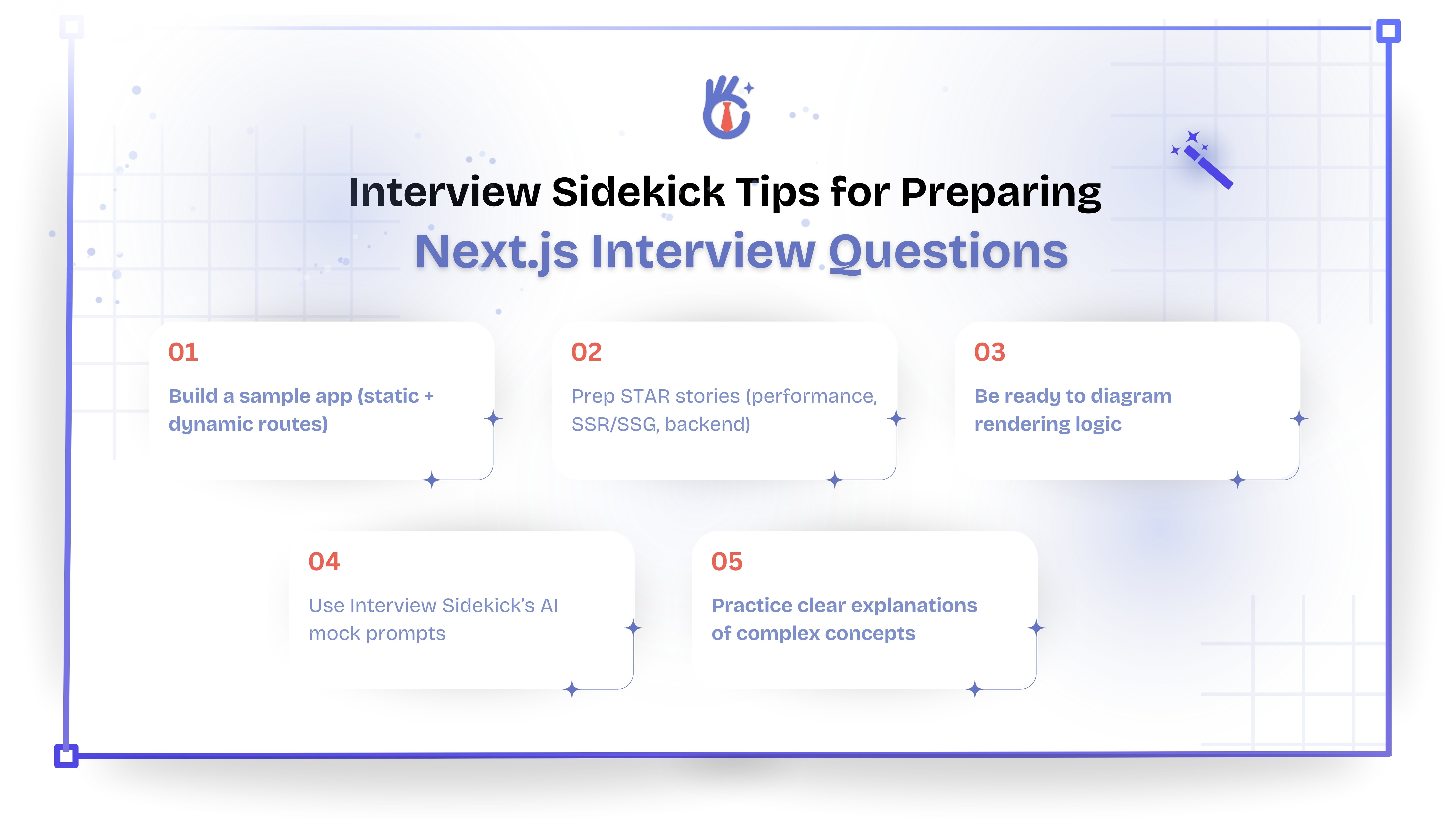
Build and deploy a sample App Router project with static, dynamic, and streamed routes.
Prepare 3-4 STAR stories about performance tuning, backend integration, and SSR/SSG use cases.
Be ready to whiteboard or diagram the rendering and caching flow during interviews.
Use Interview Sidekick's AI mock prompts to simulate technical interviews.
Practice explaining complex Next.js concepts in simple, confident language.
Final Thoughts: Nail Next.js Interview Questions With STAR Clarity
Next.js interviews are your chance to show you're not just a React developer - you're someone who builds scalable, production-ready apps with modern rendering, caching, and data-fetching patterns. Master the App Router fundamentals, prepare real STAR stories, and practice out loud with Interview Sidekick to walk in confident.